

Kurzfassung:
- Manufacturers face costly inefficiencies due to disconnected data systems that hinder rapid decision-making. Successful data integration improves KPIs like delivery, quality, and maintenance, offering significant ROI and structural competitive advantages. Phased, decision-led approaches and proper governance are essential to avoid common pitfalls and achieve reliable, scalable integration outcomes.
Most manufacturing operations are drowning in data but starving for insight. You have ERP records, machine logs, quality reports, and shift notes, yet none of them talk to each other. The result is costly. Manufacturers relying on manual data reconciliation lose $847,000 annually, and that figure does not account for the slower decisions, undetected quality issues, and missed delivery windows that compound the damage. Understanding why integrate manufacturing data is no longer an academic question. It is a financial and competitive one that operations managers cannot afford to ignore.
| Punkt | Details |
|---|---|
| Data volume is not enough | Accumulating data without integration creates silos and obscures the inefficiencies you need to fix. |
| Integration delivers measurable ROI | Integrated systems yield 317% ROI over three years and 5x faster operational decisions. |
| Governance comes before technology | Aligning KPI definitions and business rules before building dashboards is what separates adoption success from failure. |
| Architecture matters at scale | Point-to-point connections become unmanageable fast. Unified Namespace or hub-and-spoke designs scale reliably. |
| Implementation should be phased | Start with a clear decision you want to improve, then build the data infrastructure around it. |
Manufacturing data integration is the practice of connecting disparate systems so that information flows consistently and automatically across your operation. That includes your ERP system, your MES, IoT sensors on the shop floor, quality management software, and in many plants, legacy machinery that predates modern networking standards.
The challenge is not just technical. It is architectural. Two broad approaches dominate current thinking:
Most plants face a deeper problem than choosing between these two. They are dealing with systems that were never designed to communicate: a 2008 SCADA system, a cloud-based ERP, a standalone quality database, and sensors that speak entirely different protocols. Diverse systems create silos that require ISA-95 compliant, hub-and-spoke, or Unified Namespace architectures to resolve properly.
Standards like OPC UA and MQTT with Sparkplug B have emerged to address the semantic gap, which is the problem of two systems sending the same measurement in different formats, units, or naming conventions. Without a standardised data model, your integrated data will conflict rather than cohere.
Pro-Tipp: Before selecting any integration architecture, audit every data source in your plant and document what protocol, format, and update frequency each one uses. This single step prevents the majority of mid-project surprises.
This is where the case for integration becomes concrete. The benefits of data integration are not abstract efficiency gains. They are measurable improvements to the KPIs your business runs on.
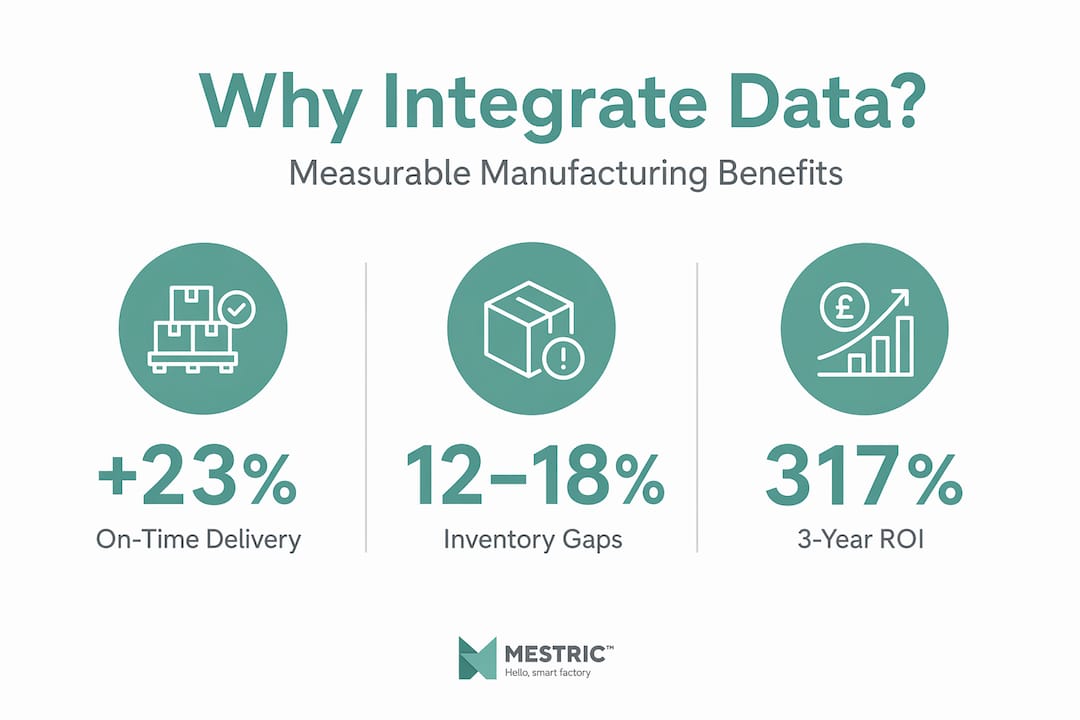
Consider delivery performance. Integrated systems improve on-time delivery by 23%. That comes from having production status, inventory levels, and logistics data visible in one place rather than reconciled manually every morning. When a scheduling change happens at 14:00, the right people know immediately.
Quality control tells a similar story. Manufacturers without integrated systems suffer 12 to 18% inventory accuracy gaps, take 23% longer to detect quality issues, and face average recall costs of £140,000 or more per incident. Integrated quality data, by contrast, makes defects visible the moment they occur. You can trace a non-conformance back to a specific machine, shift, batch, or supplier within minutes. Explore how this connects to better outcomes in manufacturing quality control.
The decision-making impact is equally significant. 84% of users report 5x faster decisions after integration, and the average return on investment reaches 317% over three years. The mechanism is straightforward: when your data is unified, you stop spending time reconciling spreadsheets and start acting on what the data is telling you.
The specific operational benefits include:
Understanding the role of data in manufacturing makes clear that these are not incremental improvements. They are structural advantages.
The importance of manufacturing data goes unrecognised not because leaders lack ambition, but because integration projects often fail in predictable ways. Knowing these pitfalls in advance changes your outcomes significantly.
1. The N² connection problem
Point-to-point integration means connecting System A directly to System B, System C, System D, and so on. With just ten systems, that creates up to 45 separate bilateral connections, each requiring its own maintenance and monitoring. A Unified Namespace architecture solves this by routing all data through a single communication broker. Adding a new system means one new connection, not ten.
2. Assuming a dashboard is the same as integration
Many plants invest in a business intelligence tool and assume they have solved the data problem. They have not. Without aligned KPI definitions and clear business rules, you get dashboards that different teams interpret differently. Aligning KPIs and governance before technical implementation is what produces dashboards people actually trust and use.
3. Neglecting legacy devices
Replacing a functional CNC machine because it lacks a modern network interface is expensive and disruptive. Retrofitting with edge devices or protocol translators keeps the machine producing while bringing its data into your integration layer. The key is doing this without interrupting production schedules.
4. Skipping data governance
Data governance creates dependency on integrated data. When teams are required to use the integrated system for their daily decisions, data quality issues surface quickly and get resolved. Without governance, teams revert to their old spreadsheets and your integration investment sits idle.
5. Building for today only
Federated data spaces are becoming the forward-looking architecture for manufacturers who need to share operational data across supply chains or multiple sites while maintaining control of what they share and with whom. Building your current integration with this in mind saves costly redesign later.
Pro-Tipp: If you are unsure where to start with governance, pick one operational decision you want to improve, identify the data that informs it, and define exactly how that data should be collected, calculated, and displayed. Build governance outward from that single decision.
A phased approach consistently outperforms the attempt to connect everything at once. Here is a comparison of two common implementation philosophies:
| Ansatz | Starting point | Typical timeline | Risk level | Outcome |
|---|---|---|---|---|
| Big-bang integration | Technology selection first | 18 to 24 months | Hoch | Frequent adoption failures |
| Decision-led, phased rollout | Operational decision first | 8 to 12 weeks per phase | Niedrig bis mittel | Higher adoption and faster ROI |
The decision-led approach, as described in manufacturing analytics consulting best practice, starts by asking which operational decision is currently made with the poorest information. You then define the KPIs that should inform that decision, identify the source data, and build the minimum viable integration to make that decision faster and more accurate.
Practical steps to follow:
Track the right metrics from the outset. Tracking the right KPIs from day one of your integration project keeps the focus on outcomes rather than features.
I have worked with enough manufacturing plants to see a consistent pattern. The ones that struggle most are not the ones without data. They are the ones with plenty of data that they cannot act on. Screens full of numbers, reports generated overnight, spreadsheets emailed between departments. And yet, when something goes wrong on the floor, it takes hours to understand why.
What I have learned is that the missing ingredient is rarely technology. It is connection. Not just between systems, but between the data and the decision it is supposed to inform. I have seen plants where integration projects were considered complete because the systems were technically linked. But the operators still maintained their own logs because they did not trust the new dashboard. The integration existed. The dependency did not.
The plants that get this right start with a specific operational problem, build their integration around it, and make it impossible to run that process without the integrated data. That is how you create genuine adoption, and genuine adoption is what drives quality improvement over time.
I am also convinced that manufacturers who delay integration thinking they will “do it properly later” are making a competitive choice. Data treated as a strategic asset is what separates digital leaders from the rest. The gap between those two groups is widening every year. The good news is that with the right architecture and a decision-led approach, you can close that gap faster than most people expect.
— Andraž
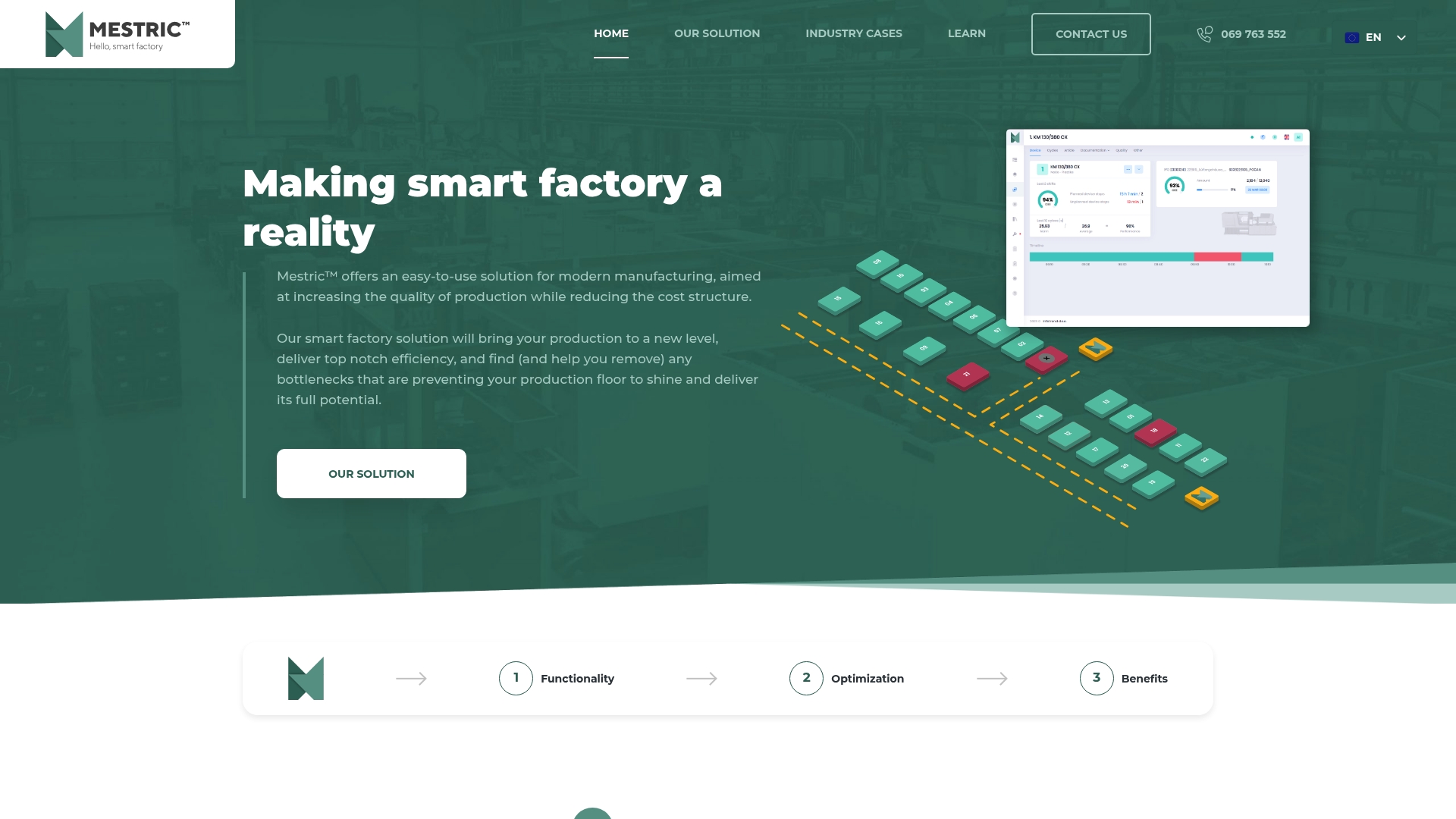
Mestric is built specifically for manufacturing operations that need real results, not a multi-year transformation project. The platform connects directly to your production equipment, bringing machine performance, quality data, and downtime information into a single, clear view. Whether you are working with modern networked machinery or older shop floor equipment, Mestric is designed to minimise disruption during setup.
For operations managers looking to move from reactive to proactive management, Mestric’s production efficiency tools give you the real-time KPI visibility needed to act on problems before they affect output. The platform also supports integration with your existing ERP system, so your plant floor data and your business data finally speak the same language.
If you want to understand what integrated data looks like in practice for your specific operation, Mestric offers an onsite presentation to walk through the capabilities with your team. You can also explore Arten von Fertigungssoftware to understand where an MES fits within your broader technology stack.
Manufacturing data integration connects separate systems, such as ERP, MES, IoT sensors, and quality tools, so that data flows automatically between them. The goal is a single, accurate picture of your operation rather than separate data silos.
Reports built from disconnected systems are slow, inconsistent, and require manual reconciliation. Integrated data gives you real-time visibility, removes the risk of conflicting figures, and accelerates decision-making by up to five times compared to manual processes.
A phased, decision-led approach can deliver the first measurable improvements within 8 to 12 weeks. Full integration across complex multi-system environments typically takes longer, but value does not have to wait for completion.
Data integration projects yield an average ROI of 317% over three years, with measurable improvements in on-time delivery, downtime reduction, and quality detection speed that contribute directly to cost savings and revenue performance.
The most common cause of failure is starting with the technology rather than the operational decision you want to improve. Without aligned KPI definitions and a governance framework, even well-connected systems produce dashboards that teams do not trust or use.


 069 763 552