


TL;DR:
- A Manufacturing Execution System (MES) converts real-time shop floor data into immediate actionable insights, preventing revenue loss caused by inefficiencies. It enhances manufacturing performance through improved visibility, automation, and quality control, leading to significant cost savings and waste reduction. Selecting and deploying an MES with clear KPIs and operator involvement maximizes benefits and transforms factory management into a continuous improvement process.
A Manufacturing Execution System (MES) is defined as real-time shop floor software that sits between your ERP system and factory operations, converting live production data into decisions you can act on immediately. Manufacturers without MES lose 5–8% of annual revenue to inefficiencies. That figure alone explains why platforms like Epicor Kinetic MES, Simplico, and Scaled Solutions have become standard infrastructure in competitive plants. The benefits of MES systems extend well beyond basic tracking: they close the visibility gap between planning and execution, reduce manual errors, and give production managers the data they need to act before problems escalate.

MES delivers operational improvements by replacing guesswork with live production intelligence. The most direct gains appear in three areas: visibility, automation, and equipment performance.
Real-time production visibility is the foundation. Manufacturers face a ‘visibility gap’ between what the ERP plan says should happen and what is actually occurring on the shop floor. MES closes that gap by feeding a single, trusted source of live data to every level of management. You stop relying on end-of-shift summaries and start making decisions in the moment.
Automated data collection removes the error-prone manual logs that distort your performance picture. When operators no longer transcribe counts and cycle times by hand, the data you receive is accurate and timestamped. Shift report preparation drops from 30 to 60 minutes of manual work to automatic generation, freeing supervisors for higher-value tasks.
Overall Equipment Effectiveness (OEE) is where the financial impact becomes tangible. MES can improve OEE by 5–15 percentage points and reduce unplanned downtime by 20–40%. Those are not marginal gains. A 10-point OEE improvement on a line running at 65% means you are producing the same output with significantly less machine time and overhead.
Downtime reduction comes from immediate alerts and root cause tracking. When a machine stops, MES records the reason, the duration, and the operator on shift. Over weeks, that data builds a Pareto chart of your most costly failure modes, letting maintenance teams target the right problems first.
Pro Tip: Audit your current OEE estimate against the figure MES produces after its first week of live data. Most plants find their actual OEE is 20–30 percentage points lower than manual estimates, because MES captures micro-stops and slow cycles that paper logs miss entirely.
Quality control is one of the strongest arguments for MES adoption. The system automates quality inspections by recording measurement data at each production stage and flagging defects the moment a parameter drifts out of tolerance. You catch problems at the source rather than at final inspection, which is where correction costs are lowest.
Batch and operator traceability is a capability that manual systems cannot replicate at scale. MES links every finished unit to the batch of raw material, the machine it ran on, and the operator who produced it. When a customer reports a defect, you can trace the affected production window in minutes rather than days. That speed matters enormously in regulated industries such as automotive, medical devices, and food processing.
Automatic quarantine and alerting prevents non-conforming product from advancing down the line. When MES detects an out-of-tolerance reading, it can trigger a hold flag on the affected batch and notify quality engineers immediately. The cost of catching a defect at the point of production is a fraction of the cost of a customer return or a regulatory recall.
Audit readiness improves because MES maintains a complete, timestamped quality record without any manual filing. ISO 9001, IATF 16949, and FDA 21 CFR Part 11 audits become straightforward when every inspection result, corrective action, and operator sign-off is stored and searchable. Plants that previously spent weeks preparing audit documentation report that MES reduces that preparation to hours.
The cost advantages of MES are direct and measurable. Automation reduces the manual errors and redundant paperwork that quietly inflate your cost per unit. When operators no longer re-enter data from paper travellers into spreadsheets, transcription errors disappear and the time spent on administrative tasks drops significantly. For a detailed breakdown of where these savings accumulate, the cost reduction strategies that MES enables across scrap, labour, and inventory are worth reviewing.
Inventory control tightens when MES integrates with your ERP. The system updates inventory automatically in real time as materials are consumed, keeping stock levels accurate without manual cycle counts. You avoid both the cost of surplus stock and the production disruption of unexpected shortages.
Scrap and material waste fall because MES monitors process parameters continuously. A deviation in temperature, pressure, or cycle time triggers an alert before it produces a full batch of rejects. Plants using MES for real-time process monitoring consistently report scrap reductions of 10–25% within the first year of deployment.
Labour costing becomes accurate rather than estimated. MES records operator activity per machine and per shift, feeding precise labour cost data into your ERP or costing system. You can identify which products carry the highest labour cost and where productivity varies between shifts, giving you a factual basis for scheduling and workforce decisions.
Pro Tip: Connect your MES labour data to your job costing module in the first month. The gap between estimated and actual labour hours on specific products is often where the largest hidden cost variances live, and it is invisible without real-time tracking.
Spreadsheets, homegrown Access databases, and basic ERP production modules share a common limitation: they report on what has already happened. MES acts as the ‘central nervous system’ of the factory, converting raw real-time data into a single source of truth. The difference is not just speed. It is the ability to intervene before a problem becomes a loss.
ERP production modules are designed for planning, not execution control. They tell you what should happen by shift end. MES tells you what is happening right now, at machine level, with alerts when reality diverges from the plan. For a direct comparison of how these approaches perform in practice, the MES vs traditional manufacturing analysis covers the key operational differences.
MES platforms support IoT connectivity and advanced analytics, enabling smart factory capabilities that no spreadsheet or basic ERP module can match. This is the foundation of Industry 4.0 readiness: machine data feeds directly into the MES without human transcription, and the system applies analytics to surface patterns that would take a human analyst weeks to find manually.
| Feature | Spreadsheets / manual tools | ERP production module | MES |
|---|---|---|---|
| Data latency | Hours to days | End of shift | Real time |
| Error source | Manual entry | Manual entry | Automated capture |
| OEE tracking | Estimated | Planned vs actual | Live, machine-level |
| Quality traceability | Limited | Batch level | Unit and operator level |
| IoT / Industry 4.0 | None | Limited | Native support |
| Scalability | Poor | Moderate | Multi-line, multi-plant |
Selecting the right MES starts with defining what you want to measure before you evaluate any software. Plants that begin with vague goals such as “improve efficiency” rarely achieve the ROI that plants with specific KPI targets do.
MES systems deliver measurable gains in efficiency, quality, and cost control by replacing manual reporting with real-time, machine-level data that managers can act on immediately.
| Point | Details |
|---|---|
| OEE improvement | MES raises OEE by 5–15 points and cuts unplanned downtime by 20–40%. |
| Hidden efficiency losses | Actual OEE is often 20–30 points below manual estimates once MES captures micro-stops. |
| Quality traceability | MES links every unit to batch, machine, and operator for fast defect root cause analysis. |
| Cost savings | Real-time inventory, labour tracking, and scrap alerts reduce cost per unit across all lines. |
| Implementation approach | Pilot on one line with defined KPIs before scaling to avoid adoption risk. |
I have spent years working with production teams who believed their OEE was in the high seventies. When MES went live on their lines, the real figure was closer to fifty. That gap is not incompetence. It is the natural result of manual reporting, where operators record what they remember rather than what the machine actually did.
The shift MES creates is not just technical. It is cultural. When every supervisor can see live performance data on a screen, accountability moves from the end-of-week review to the present moment. Conversations change from “what went wrong last Tuesday” to “line three is running at 60% right now, what do we do about it.” That is a fundamentally different way of managing a factory, and it is one that continuous improvement programmes like Lean and Six Sigma have always needed but rarely had the data infrastructure to support.
My strongest advice: do not wait until you have a perfect data environment to start. Pick your worst-performing line, define two KPIs, and go live. The data you collect in the first 30 days will tell you more about your real production losses than any manual report has in the past five years.
— Andraž
If the efficiency and quality gains described above are relevant to your plant, Mestric is built to deliver them without the complexity of a traditional MES implementation.
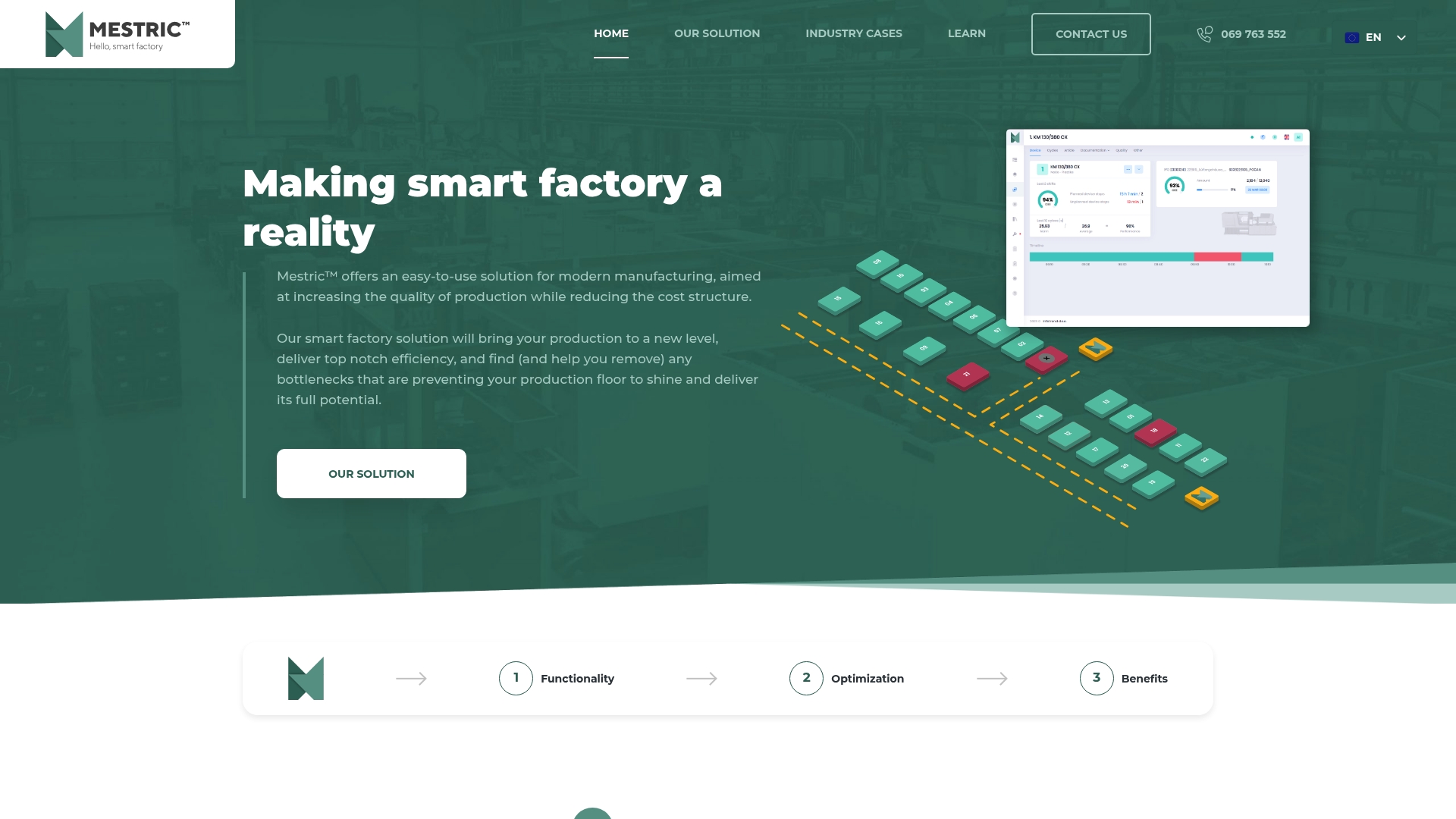
Mestric connects directly to your manufacturing equipment and surfaces live KPIs including OEE, downtime, quality parameters, and labour cost, all in one place. The platform integrates with your existing ERP and includes AI-powered tools that identify bottlenecks and flag process deviations before they become costly. Whether you are evaluating manufacturing software options for the first time or replacing a legacy system, Mestric offers an onsite demonstration so you can see connected machinery data in your own production environment. Explore how Mestric supports production efficiency in 2026 and request a demonstration today.
MES systems improve OEE by 5–15 percentage points, reduce unplanned downtime by 20–40%, and lower scrap and labour costs through real-time data capture and automated reporting. They also provide full quality traceability and audit-ready records.
Spreadsheets record what has already happened and rely on manual entry, which introduces errors and delays. MES captures machine data automatically in real time, giving managers the ability to act on problems as they occur rather than after the shift ends.
MES automates data collection directly from machines and inspection points, removing the transcription step where most manual errors occur. Shift reports, quality records, and inventory updates are generated without operator data entry.
A single-line pilot with a platform like Mestric or Epicor Kinetic MES can go live in four to eight weeks, depending on machine connectivity and data readiness. Full multi-line deployment typically follows a 90-day pilot review.
MES is suitable for any plant where production losses, quality defects, or manual reporting consume significant time or cost. Cloud-based platforms have reduced the upfront investment substantially, making MES accessible to plants with as few as one or two production lines.


 069 763 552