

AI process optimisation means using machine learning on your machine, quality and production data to find losses, predict problems and adjust how a line runs. It works when the data is reliable, the goal is specific (for example fewer stoppages) and you start with a small pilot. This guide shows what to optimise first, what data you need, how to connect machines, how to measure results and where to get support in Slovenia.
In manufacturing, AI is used to raise efficiency, quality and reliability. According to a University of Ljubljana lecture on new AI technologies in production, this includes automatic defect control, predictive maintenance, adjusting machine operation and energy use, and supporting production planning.
The Jožef Stefan Institute’s work on intelligent control systems for Factories of the Future describes process optimisation with AI as handling large volumes of data, machine learning and advanced statistics for monitoring, diagnostics and optimisation of systems. The same source stresses joining individual solutions, such as AI, industrial IoT, digital twins, predictive maintenance and an integrated MES, into one whole.
That last point matters. AI on its own is a calculation. It becomes useful when it sits on top of live data from your machines and returns a recommendation to the people who run the line.
A review of AI applications in manufacturing lists predictive maintenance, quality assurance, energy forecasting and supply-chain management, including forecasting demand and component lead times, as ways to avoid unplanned downtime.
| Area | What AI does | Typical goal |
|---|---|---|
| Predictive maintenance | Detects patterns that precede a failure | Fewer unplanned stoppages |
| Quality control | Flags defects and drifting parameters | Less scrap and fewer complaints |
| Process parameters | Suggests settings per product and machine | Faster, more stable runs |
| Energy | Forecasts and adjusts consumption | Lower energy cost |
| Planning | Uses historical and live data to react to events | Better use of resources and stock |
A Slovenian study on AI in production planning notes that machine learning uses historical and real-time data to respond better to predictable and unpredictable events and to optimise resources, inventory and decisions.
KLS Ljubno, a Slovenian SME, used AI to predict the reliability of parts. According to the European Big Data Value Forum material on AI Factories, this cut long-term part failure rates by 15% and shortened the reliability evaluation from 8 days to one night. It shows the pattern to look for: a measurable problem, enough data and a narrow question.
If you want a deeper walk-through of one area, our pages on predictive analytics in manufacturing and AI-driven process control examples go into practical cases.
Energy is often the quickest place to look for savings, and the general principles in this guide to optimising business energy consumption apply when you review what your lines draw and when.
A survey of 141 Slovenian manufacturing companies, described in a paper on the use of AI in Slovenian manufacturing, found that only 8% used AI for production process improvements, 12% for quality control and 8% for predictive maintenance. The survey dates from 2022, so adoption has likely moved since. The takeaway is that the field is still open, and a plant that builds its data foundation now is not late.
Most AI projects fail on data, not on algorithms. The Slovenian national AI strategy, NsUI 2030, points to quality, traceable data from machines, sensors, production, quality, maintenance and business systems, with integrated data flows and connected production and business systems.
The Chamber of Commerce and Industry of Slovenia (GZS) adds practical requirements in its guide to deploying AI: data infrastructure, digitised operational records, specialised software, computing capacity, dedicated hardware where needed and support staff.
A short readiness check:
If the answer to most of these is no, the first project is not AI. It is data capture.
Plants rarely have a single generation of equipment. Older machines may speak serial protocols, newer ones standard industrial interfaces, and some have no data output at all. The usual approach is to collect signals from machines automatically, standardise them in one platform and only then apply analytics and AI.
That is the role of a Manufacturing Execution System (MES). It links to equipment, records production, downtime and quality in real time, and gives the AI layer something trustworthy to work on. Our guide for plant engineers covers nine steps to integrate machines with an MES, and the benefits of connected machinery explain what changes once the data flows.
Keep three things in mind when you plan the connection:
Finance Tovarna, reporting in October 2025 on when a company is ready for AI in production, says a Slovenian company is ready when key processes are digitised, there is a data culture and a clear goal, such as fewer stoppages, better quality or lower energy costs. It recommends consolidated data from machines, sensors and systems, basic analytics, KPIs, trained staff and gradual pilots.
A GZS seminar roadmap, listed on the GZS events page, follows a similar line: begin with clean data and knowledge capture from production, then move from manual rules and decisions toward agent-based AI.
In practice, that gives you five steps:
The same Finance Tovarna article advises setting clear goals, introducing basic analytics and KPIs to understand processes, and updating metrics regularly based on what the analytics show. Make it concrete:
| KPI | What to compare | Why it matters |
|---|---|---|
| Unplanned downtime | Minutes per shift before and after | Shows the effect of predictive maintenance |
| First-pass yield / scrap | Share of good parts on first run | Shows quality gains |
| OEE | Availability, performance, quality | One number for line health |
| Energy per unit | kWh per good part | Shows energy optimisation |
| Changeover time | Minutes per changeover | Shows planning and setup gains |
Always compare like for like: the same product mix, the same line, the same shift pattern. Live dashboards make this simple, and our real-time production monitoring guide shows how KPIs are tracked automatically.
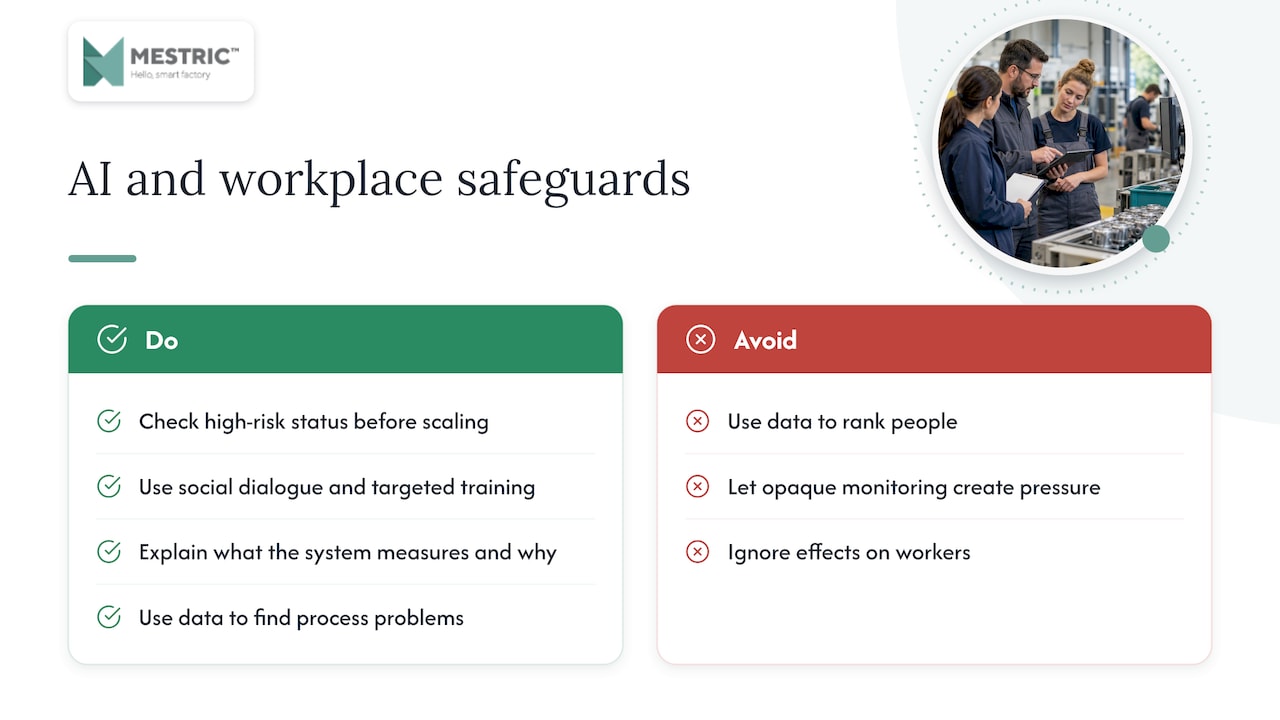
The GZS guide lists employee resistance, privacy breaches and the EU AI Act among the main risks. It notes that high-risk AI classification brings strict logging and oversight duties. Check whether your planned use falls into a high-risk category before you scale. A system that only recommends maintenance timing is a different case from one that affects worker safety or employment decisions.
Workforce concerns are real: job loss, less human contact and the need for new digital skills. The same guide says addressing them takes social dialogue and targeted training. NsUI 2030 also stresses transparency, privacy, non-discrimination and attention to the effect of AI on employment and working conditions, with social partners involved.
Jožef Stefan Institute researchers make a useful point: the goal of automation is not necessarily to replace people. Repetitive tasks move to automated systems, while employees supervise, make real-time decisions and look for improvements in quality, cost and maintenance.
One more caution comes from the OECD’s work on AI in the workplace: AI can make work safer by taking over dangerous tasks, but it can raise stress if systems are opaque or monitoring creates excess performance pressure. Show operators what the system measures and why, and use the data to find process problems, not to rank people.
The government’s national AI ecosystem page says plants can use European Digital Innovation Hubs (EDIHs) for digital-maturity assessments and test-before-invest, while KCUI and SLAIF provide AI guidance, infrastructure, support and training. NsUI 2030 was adopted on 5 March 2026 to guide responsible and inclusive AI development. Check the official pages for current programmes and calls, as these change.
Our perspective
We see the same pattern in plants again and again: the AI conversation starts with algorithms and should start with the shop floor. If a machine’s stoppage reasons are written on paper at the end of a shift, no model can learn from them.
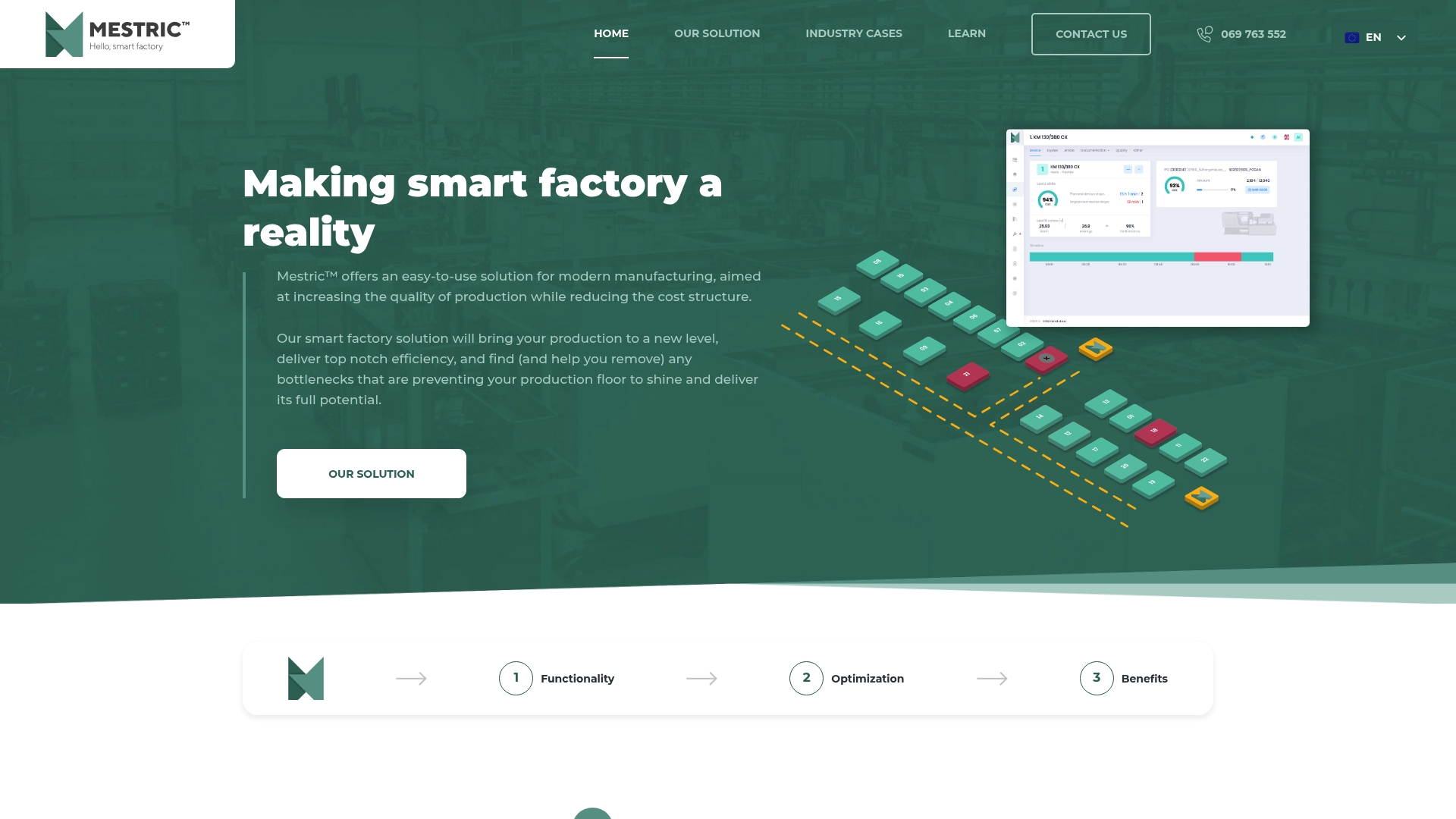
That is why we build Mestric™ as an MES first. It connects directly to equipment, collects data automatically and shows KPIs such as performance, downtime, quality parameters and cost in real time. Once that foundation is in place, AI-powered recommendations for quality and process norms have real data to work with, and production managers can act on them the same day.
Our advice is simple. Pick one bottleneck, connect it, measure it for a few weeks and let the numbers tell you where AI should go next.
Andraž
Mestric™ is an easy-to-use MES that links to your machines and turns live data into KPIs, downtime analysis, quality monitoring and AI-supported optimisation. It is sold as a subscription, and we usually begin with a demonstration. We can show how connected machinery works in a real production environment in our demo centre.
See the Mestric™ MES solution or visit mestric.com to arrange a presentation. To compare approaches first, read MES versus traditional manufacturing.
Not for a first pilot. You need someone who owns the data and the KPI, plus support from a platform or partner. The GZS guide lists support staff among the requirements, and Slovenian EDIHs, KCUI and SLAIF offer guidance and training.
It depends on the question. Predicting a failure needs history of both normal running and stoppages with their causes. Start collecting automatically now, because data you did not record cannot be recovered later.
Often yes, if signals can be read from the machine or added with sensors and a gateway. The aim is automatic, consistent data capture, not new equipment everywhere. Begin with the machines that cause the most loss.
A focused pilot is usually planned over weeks to a few months. Results depend on your baseline, data quality and the goal, so measure before and after on the same line and product mix.


 069 763 552