


TL;DR:
- Quality monitoring tools utilize AI, sensors, and analytics to detect defects, ensure compliance, and optimize manufacturing processes. Leading platforms like MachineMonitor, PAICe Monitor, Qualix, and Ellab EMSuite address predictive maintenance, process analysis, data quality, and environmental regulation adherence. Selecting the right tool depends on risk, environment, and system integration to improve quality continuously.
Quality monitoring tools are defined as software and sensor-based systems that capture, analyse, and report production data to prevent defects, reduce downtime, and maintain regulatory compliance. The best examples of quality monitoring tools in manufacturing today combine AI-driven anomaly detection, real-time data capture, and audit-ready documentation. Platforms such as MachineMonitor, PAICe Monitor, Qualix, and Ellab EMSuite each address a distinct layer of quality assurance, from predictive maintenance on the shop floor to environmental compliance in regulated facilities. Understanding which tool fits your operation is the first step towards measurable quality improvement.
AI-powered quality monitoring is no longer the preserve of large enterprises with dedicated data science teams. Modern AI tools enable non-experts to deploy advanced monitoring with ease via simplified model training and automated alerts, making predictive maintenance accessible to any plant manager.

MachineMonitor is one of the clearest examples of this shift. The platform uses AI algorithms to compare each production cycle against a baseline profile, detecting early signs of tool wear and bearing degradation before they cause unplanned stoppages. When deviations are detected, the system automatically sends SMS and email alerts to maintenance teams, removing the need for manual inspection rounds.
What makes MachineMonitor particularly practical is its single-click model training. The system learns what “normal” looks like for each machine without requiring a data engineer. Status updates display as OK or ANOMALY, giving operators an immediate, unambiguous read on machine health.
Key capabilities of AI-driven monitoring tools like MachineMonitor include:
Pro Tip: When deploying an AI monitoring tool for the first time, run the baseline training period during a known-good production run. Any data captured during a fault condition will corrupt the normal profile and generate false positives.
Standard Statistical Process Control charts are often insufficient for complex manufacturing environments. Tools offering smart contextualisation accelerate root cause analysis by ingesting MES data automatically, going well beyond what a traditional Shewhart chart can reveal.
PAICe Monitor, developed by Cohu, is designed specifically for semiconductor and high-precision manufacturing. It analyses non-linear multivariate process data to uncover hidden relationships between process variables that would be invisible to single-variable SPC methods. The platform can identify root causes within minutes rather than hours.
The workflow PAICe Monitor supports follows a clear progression:
Integrating quality monitoring data with MES systems enhances the ability to pinpoint issues and optimise production workflows dynamically. PAICe Monitor is built on this principle, treating MES integration not as an add-on but as the foundation of its analytical capability.
Data quality governance is a growing priority for manufacturing teams that rely on connected systems and digital records. Poor data quality in a production database does not just cause reporting errors. It can trigger incorrect reorder decisions, mask genuine process drift, and undermine audit submissions.
Qualix addresses this by continuously scoring datasets across seven dimensions, including completeness, accuracy, consistency, and timeliness, applying plain-English rule definitions that any quality engineer can configure without SQL expertise. Scores are calculated daily, and when a dataset falls below a configurable threshold such as 80%, the system triggers a severity alert. This means your team knows about a data quality problem before it affects a production decision.
Key features that make Qualix a practical choice for manufacturing data governance:
Pro Tip: Segment your data assets by criticality before configuring Qualix thresholds. A raw sensor log and a batch release record do not carry the same risk, so they should not share the same alert threshold.
Real-time architectures take this further. Systems using Apache Kafka and Apache Flink achieve sub-10ms latency and validate six core data quality dimensions every 60 seconds using sliding window checks. For high-volume production lines, this level of continuous validation is the difference between catching a data anomaly in real time and discovering it during a weekly report review.
Environmental monitoring is a non-negotiable requirement in pharmaceutical, food, and medical device manufacturing. Temperature excursions, humidity fluctuations, and CO₂ deviations can render entire batches non-compliant, and manual logging simply cannot provide the audit trail that regulators demand.
Ellab EMSuite is one of the top quality assurance tools for regulated environments. It provides 24/7 environmental monitoring compliant with GxP and FDA 21 CFR Part 11, automating data capture and documentation to maintain continuous audit readiness. The platform monitors temperature, humidity, CO₂, differential pressure, and other critical parameters across multiple zones simultaneously.
Compliance in regulated manufacturing requires more than data capture. Audit trails recording all system events, including alarms, user actions, and configuration changes, are critical for satisfying GxP, FDA, and HACCP requirements. EMSuite generates these trails automatically, removing the manual effort that creates gaps in traditional paper-based systems.
| Feature | Ellab EMSuite |
|---|---|
| Monitoring parameters | Temperature, humidity, CO₂, differential pressure |
| Compliance standards | GxP, FDA 21 CFR Part 11, HACCP |
| Deployment options | On-premises or secure Cloud SaaS |
| Alert delivery | Custom alerts via dashboard, email, and SMS |
| Audit trail | Automated, continuous, covers all user actions |
The choice between on-premises and Cloud SaaS deployment depends on your IT infrastructure and data sovereignty requirements. Both options deliver the same monitoring capability, but Cloud SaaS reduces the burden on internal IT teams and supports multi-site deployments without additional server hardware.
Quality monitoring tools do not operate in isolation. They generate data that feeds into broader quality management processes, including deviation management, corrective and preventive action (CAPA), and change control. When these processes remain manual, the value of real-time monitoring data is often lost.
Fully configurable eQMS platforms that support deviation management and CAPA reduce fragmented manual effort and improve regulatory readiness. Ace Enterprise from PSC Software is one example, providing a structured digital environment where monitoring alerts can be escalated directly into formal quality workflows. This closes the loop between detection and resolution.
The practical benefit for plant managers is traceability. When a quality monitoring tool flags an anomaly, the eQMS records who acknowledged it, what investigation was conducted, and what corrective action was taken. This chain of evidence is what regulators and auditors look for, and it is what manual systems consistently fail to provide.
Selecting the right tool depends on your production environment, regulatory obligations, and the technical capability of your team. The table below compares the four primary tools discussed in this article across the dimensions that matter most to plant managers and quality assurance teams.
| Tool | Primary use case | Ease of use | MES integration | Compliance focus |
|---|---|---|---|---|
| MachineMonitor | Predictive maintenance, anomaly detection | High (no-code) | IoT/sensor based | General manufacturing |
| PAICe Monitor | Multivariate process analytics | Moderate | Native MES/logistics | Semiconductor, high-precision |
| Qualix | Data quality governance | High (plain-English rules) | Database level | Data-driven operations |
| Ellab EMSuite | Environmental monitoring | High | Sensor and Cloud | GxP, FDA, HACCP regulated |
For general manufacturing with mixed equipment, MachineMonitor delivers the fastest time to value. For semiconductor or high-precision environments where yield loss is expensive, PAICe Monitor’s multivariate analysis capability justifies the additional configuration effort. Ellab EMSuite is the clear choice for any facility operating under GxP or FDA oversight.
When selecting and deploying a monitoring toolset, consider the following:
You can explore types of manufacturing software that complement quality monitoring, including MES platforms that provide the production context these tools depend on.
The most effective quality monitoring systems combine AI-driven anomaly detection, continuous data scoring, and automated compliance documentation to prevent defects before they reach the production line.
| Point | Details |
|---|---|
| AI tools are accessible | MachineMonitor’s single-click training removes the need for data science expertise on the shop floor. |
| Multivariate analytics outperform SPC | PAICe Monitor identifies hidden process variable relationships that standard control charts cannot detect. |
| Data governance requires continuous scoring | Qualix scores datasets across seven dimensions daily and alerts teams before quality drift affects operations. |
| Compliance demands automated audit trails | Ellab EMSuite generates continuous event logs that satisfy GxP and FDA 21 CFR Part 11 requirements automatically. |
| Tool selection should match your risk profile | Deploy monitoring where failure costs are highest and confirm MES integration before committing to a platform. |
I have seen this pattern repeatedly. A plant manager attends a trade show, sees a polished demonstration of an analytics platform, and purchases it for a facility that does not yet have reliable sensor data coming off its machines. The tool is technically impressive. It is also completely useless without clean input data.
The uncomfortable truth about implementing quality monitoring tools is that the technology is rarely the hard part. The hard part is change management. Operators who have relied on manual inspection for years do not automatically trust an algorithm that tells them a machine is about to fail. Building that trust takes time, consistent results, and visible support from plant leadership.
My recommendation is to start with the simplest tool that solves your most expensive problem. If unplanned downtime is your primary cost driver, an AI monitoring tool like MachineMonitor gives you early warnings with minimal configuration. If you are in a regulated environment and your audit preparation takes weeks of manual effort, Ellab EMSuite pays for itself in the first compliance cycle.
The shift towards monitoring manufacturing quality as a continuous, automated process rather than a periodic manual activity is not optional for competitive manufacturers. But the tools only work if your team understands them, trusts them, and has been trained to act on what they report. Invest as much in the implementation as you do in the software licence.
— Andraž
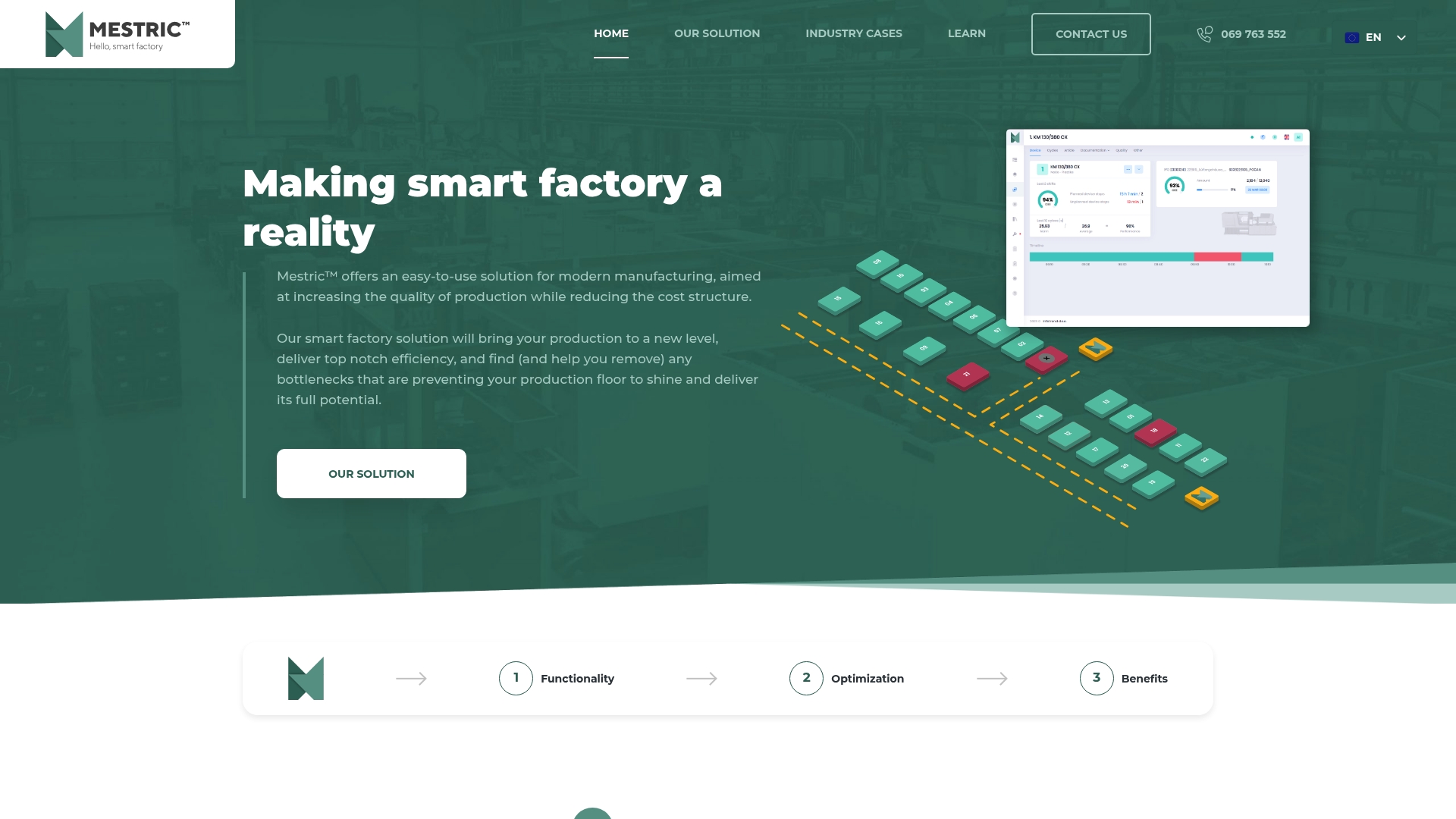
Mestric connects directly with your manufacturing equipment to deliver real-time quality monitoring, performance tracking, and productivity analytics through a single platform. Plant managers can view quality parameters, downtime data, and cost analysis in one place, with AI-powered tools that identify bottlenecks and flag deviations before they become defects. Mestric integrates with existing production systems, reducing manual data entry and giving your quality assurance team the visibility they need to act quickly. If you are ready to see how connected machinery benefits your production environment, explore Mestric’s quality monitoring solutions or request an onsite demonstration to see the platform working with your own equipment.
For additional practical context, you can also review quality monitoring examples that show how manufacturers have used real-time data to cut waste and improve output.
The main examples include AI-driven platforms such as MachineMonitor for predictive maintenance, analytics tools such as PAICe Monitor for multivariate process analysis, data governance platforms such as Qualix for continuous dataset scoring, and environmental monitoring software such as Ellab EMSuite for compliance in regulated facilities.
You connect the tool to your machines or data systems, configure baseline profiles or quality rules, and set alert thresholds for your team. Most modern platforms deliver notifications via SMS, email, Slack, or Microsoft Teams so your operators and engineers receive warnings in real time.
The primary benefits are reduced unplanned downtime, fewer defective products reaching the next production stage, and automated compliance documentation that reduces audit preparation time. Continuous environmental monitoring platforms alone can eliminate weeks of manual record compilation before a regulatory inspection.
Not with modern platforms. MachineMonitor uses single-click model training that any operator can complete, and Qualix allows quality rules to be written in plain English without SQL or coding knowledge. The barrier to entry has dropped significantly in recent years.
Platforms such as PAICe Monitor are built around native MES and logistics data integration, using production trace data to contextualise anomalies. Mestric’s MES platform also connects directly with equipment to feed quality parameters into a centralised dashboard, making MES integration a core feature rather than an optional add-on.


 069 763 552