


Production capacity planning means working out how much your plant can realistically produce, comparing that with the demand you expect, and deciding what to change when the two do not match. Done well, it tells you early which machine, shift or product mix will be overloaded, so you act before orders slip. This guide walks through the method step by step, with formulas, a worked example and the data you need to keep the plan accurate.
Capacity planning belongs to the operational stage of planning. According to CIPS, it works alongside an MRP system and makes sure resources are available and goods are routed through to the finished line. A detailed plan gives production an operational-level overview of what is needed and when.
For a plant manager, the practical value is simple:
In Slovenia the labour side deserves particular attention. The OECD’s 2024 economic survey of Slovenia describes weak manufacturing output alongside acute labour shortages, with over 40% of firms reporting shortages as a factor limiting production. A capacity plan that treats people availability as a real constraint, not an afterthought, matches that reality.
Capacity decisions work on different time scales. CIPS divides capacity management into short- and medium-term capacity review, based on a demand forecast of 2 to 18 months, and an aggregate capacity review across the whole organisation.
A useful way to organise this:
| Horizon | Question | Typical decision |
|---|---|---|
| Long term | Do we have the right machines and space? | Equipment, facility, outsourcing partners |
| Medium term | Can we cover the coming months? | Hiring, cross-training, shift patterns |
| Short term | Can this week’s schedule be run? | Overtime, reprioritising, resequencing |
Start with your sales forecast and confirmed orders. Convert both into units per week or month, by product family. Do not forecast in money, because capacity is consumed in machine hours and labour hours.
Theoretical capacity is what a machine could do running non-stop. Effective capacity is what it can deliver in practice. Capacity planning literature notes that effective capacity is typically lower than design capacity because of product mix, scheduling difficulties, machine maintenance and quality factors.
The Odette Production Capacity Assessment Tool shows which figures a serious calculation includes:
At plant level, Innoval Technology highlights three determinants: process uptime (planned and unplanned downtime and changeovers), product mix, and process efficiency for the products in the mix. Keep these three in your model and you cover most of the gap between nameplate and real output.
Take one CNC machining cell. The figures below are illustrative, not data from a real plant.
Effective weekly capacity = 65 × 40 × 0.97 = 2,522 good parts.
If the nameplate calculation had used 80 hours and no losses, it would have promised 3,200 parts. The difference of nearly 700 parts is the gap that causes missed deliveries. For a longer, copyable version of this arithmetic, see our capacity calculation with a worked example. If your cycle times come from takt time, our takt time calculation guide shows how to derive them.
Now translate demand into load. A common approach is to compare required and available capacity in hours per week for each resource, or per week for each production line. Smartsheet’s guide to rough-cut capacity planning describes the capacity-load ratio as required capacity divided by available capacity.
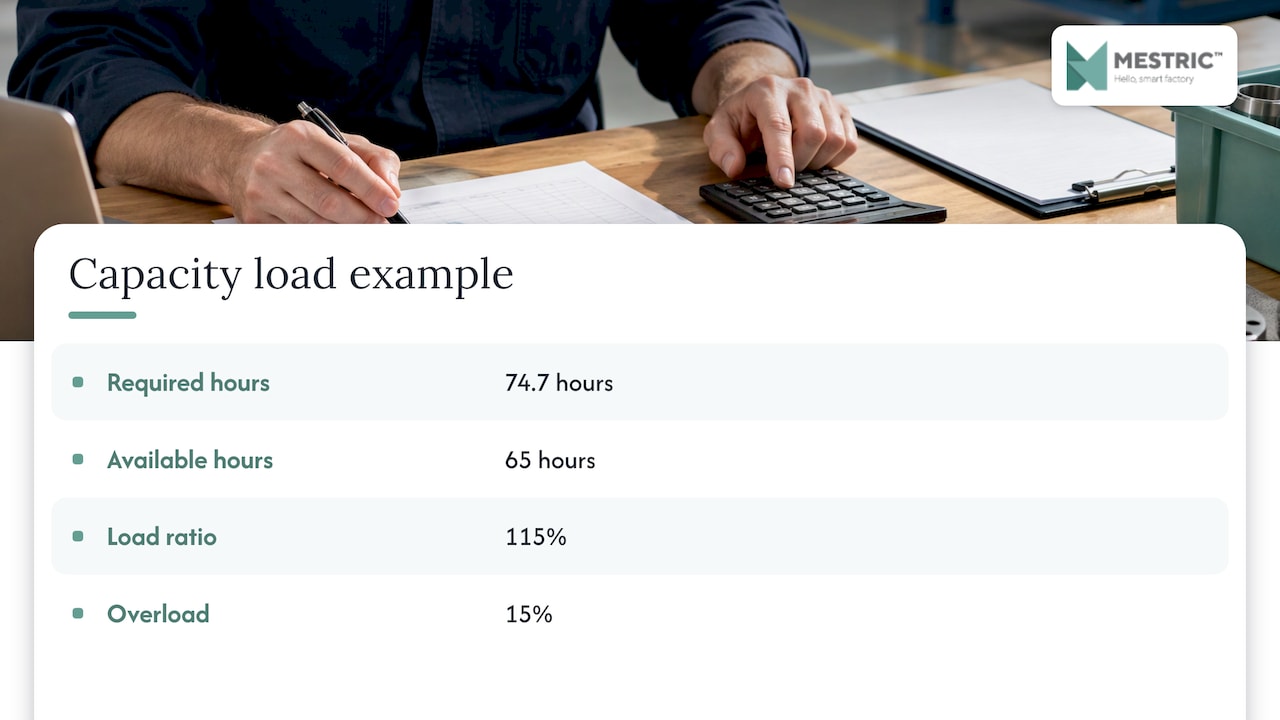
Continuing the example, suppose demand for the next four weeks requires 2,900 good parts per week from this cell. Required hours = 2,900 ÷ 0.97 ÷ 40 = about 74.7 hours. Available hours are 65.
Capacity-load ratio = 74.7 ÷ 65 = 115%.
The cell is overloaded by 15%. A ratio below 100% means spare capacity, while above 100% needs action.
Rough-cut capacity planning (RCCP) does this check against the master production schedule. As described by ETH Zurich’s course material, it converts the schedule into required capacity and tests whether key resources can produce the desired output in each period. Smartsheet adds that RCCP is a long-term technique for validating the master production schedule before excess material is purchased or released.
This is also where external limits matter. Dispatch deadlines such as shipping cut-off times mean output finished after a certain hour effectively ships a day later, so your plan should count finished and shippable capacity, not only machine hours.
Odette warns that the global load of a production means, across all products and customers, must not exceed 100%. Check each product on its own and then check the sum. A line that looks fine for each customer can still be overbooked in total.
Quickbase advises that a capacity plan should identify shortages or surpluses and locate the actual constraint before you add any resources. In practice, the resource with the highest load ratio sets the pace of the whole flow. Improving a machine that is already below 80% load changes nothing for delivery.
Look for these signs:
Our guide on how to identify production bottlenecks explains the methods in more detail, and process mapping helps you see where flow stops between operations.
When demand exceeds capacity, or falls well below it, you need a plan. CIPS describes the workflow as forecasting aggregate demand, identifying capacity plans, selecting the most suitable plan under constraints, confirming material availability and issuing work orders to production.
Quickbase lists these typical responses to a capacity gap:
Match the response to the cause. If the gap is on a machine, extra workers will not fix it, and the same source makes that point directly. If it comes from changeovers, resequencing orders by product family may recover hours at no cost. If it comes from absences or a lack of skilled operators, cross-training gives you flexibility across cells.
In our example, the 15% overload could be addressed by:
Capacity planning is cross-functional. In CIPS’s description, operations validate feasibility, procurement secures materials, planning confirms the plan and production executes the work order. Agree the plan in one meeting with all four functions, not by email chains.
Target figures alone do not establish what a line really delivers. Odette’s approach is to validate capacity through an observed production run. During the run you measure:
You then compare the observed capacity with the estimated target capacity and the customer demand, and define improvement actions. Even outside heavy industry, the same logic applies: a shop weighing in-house screen printing ROI against its monthly order volume needs measured output per run before the comparison means anything.
Quickbase adds that plans must be monitored by comparing actual demand and utilisation with the forecast, then revised when orders, projects, equipment availability or staffing change. A monthly review is a minimum. In volatile order situations, review weekly.
Spreadsheets work for a handful of machines. They struggle when cycle times drift, stops are logged by hand at the end of a shift, and the plan is updated once a week. The data feeding the capacity calculation is then days old and often incomplete.
The fix is to collect it automatically. When machines report their state, counts and stops directly, you get actual availability, performance and quality per resource without retyping. Our articles on real-time production data and machine integration explain what this changes in practice. If you want to see how plans react to disruption, our 90 day dynamic replanning pilot outlines a KPI-based approach for planners, and our line capacity playbook goes deeper into line-level planning.
We see the same pattern in many plants: the capacity plan is sound on paper, but it rests on cycle times and availability figures that nobody has measured recently. The plan then drifts away from reality, and planners spend their week explaining why.
That is why we built Mestric™ around a connection to the equipment itself. Our system is designed to collect production data automatically, show KPIs such as performance, downtime and quality parameters in real time, and give production managers a live picture of where the bottleneck is today, not last month.
Our view is that capacity planning improves most when three things come together: a clear method, like the one in this guide, trustworthy shop floor data, and fast feedback when conditions change. With those in place, the plan becomes a tool you use every day, and AI-powered optimisation can help you find process improvements you would otherwise miss.
Andraž
Mestric™ is a Manufacturing Execution System that connects directly with your manufacturing equipment and presents KPIs, downtime, quality parameters and cost analysis in one view. It is designed to help you spot bottlenecks, reduce manual errors and base capacity decisions on live figures. You can see it working in a real production environment through an onsite presentation at our demo centre.
Learn more about the Mestric™ MES platform, or read how MES compares with traditional manufacturing.
Capacity planning checks whether resources can cover expected demand over weeks or months. Scheduling decides which order runs on which machine and when, within the capacity you have. The first sets the limits, the second works inside them. Our guide to production scheduling covers the second in detail.
Review it at least monthly and whenever orders, equipment availability or staffing change significantly. Quickbase recommends comparing actual demand and utilisation with the forecast and revising the plan when those inputs shift. In unstable demand, weekly reviews are more realistic.
You need opening hours, planned and unplanned downtime, changeover time, cycle time, parts per cycle and the good-part rate. Odette’s assessment tool uses a similar set, including planned load rate and the number of direct workers. Measure them during a real production run, not from the machine’s data sheet.
First find which resource is the real constraint. Then choose the response that addresses that constraint: resequencing, reducing stops, an extra shift, cross-training, outsourcing or investment. Adding workers to a machine-limited process will not raise output.


 069 763 552