


If you run a plant in Slovenia, the main public money for digitalising production comes from the Slovenian Enterprise Fund (Slovenski podjetniški sklad, SPS). Its P4D call offers non-repayable grants of up to €100,000 for digital transformation, and its P1 plus guarantees help you finance larger investments with a bank loan. Below you will find what each scheme covers, who qualifies, where projects fail, and how a Manufacturing Execution System (MES) fits in.
The state supports digital transformation of companies in several ways. According to GOV.SI, support comes as non-repayable funds (subsidies), as repayable funds (equity, seed and venture capital, micro-loans, and guarantees with an interest-rate subsidy), or as a combination of these. For a manufacturer, three SPS products matter most.
| Scheme | Type | Key figures | Who it fits |
|---|---|---|---|
| P4D 2025 | Grant | Up to €100,000, 50% of eligible costs | Micro, small and medium-sized enterprises with a larger digital project |
| P1 plus 2026 | Bank loan guarantee with interest subsidy | 60% guarantee, loans up to €1,250,000 | SMEs financing technology-heavy investments |
| P2 2026 | Grant in tranches | Up to €72,000 | New innovative micro and small companies |
The figures above are those published for the named calls. A new call may change the budget, the percentage or the deadlines, so treat them as a guide to scale, not as a promise for next year.
P4D is the scheme most plant managers search for. The SPS call page lists non-repayable funds of up to €100,000, €22.8 million of tendered funds and 50% co-financing of eligible costs. The stated aim is to push micro, small and medium-sized enterprises toward comprehensive digital transformation of production and business processes.
A English version of the call splits the subject into two groups:
This is the area where an MES sits. Machine connectivity, automated data capture and shop floor data visualisation are the building blocks the call describes.
Our research of the call documents shows two conditions that stop many applicants early:
The €100,000 ceiling and the 50% rate therefore apply to a project of a certain size. A single-line pilot will usually not fit. Read the call documentation in full, because the definition of eligible cost, the deadlines and the scoring criteria are all there.
A digital transformation action plan is a prerequisite for applying, according to the SPS call page. Many applicants treat it as paperwork. In practice, it is the basis on which your project is later monitored, so it should reflect your real operational strategy: which processes you digitalise, which KPIs you expect to move, and who in the company owns each step.
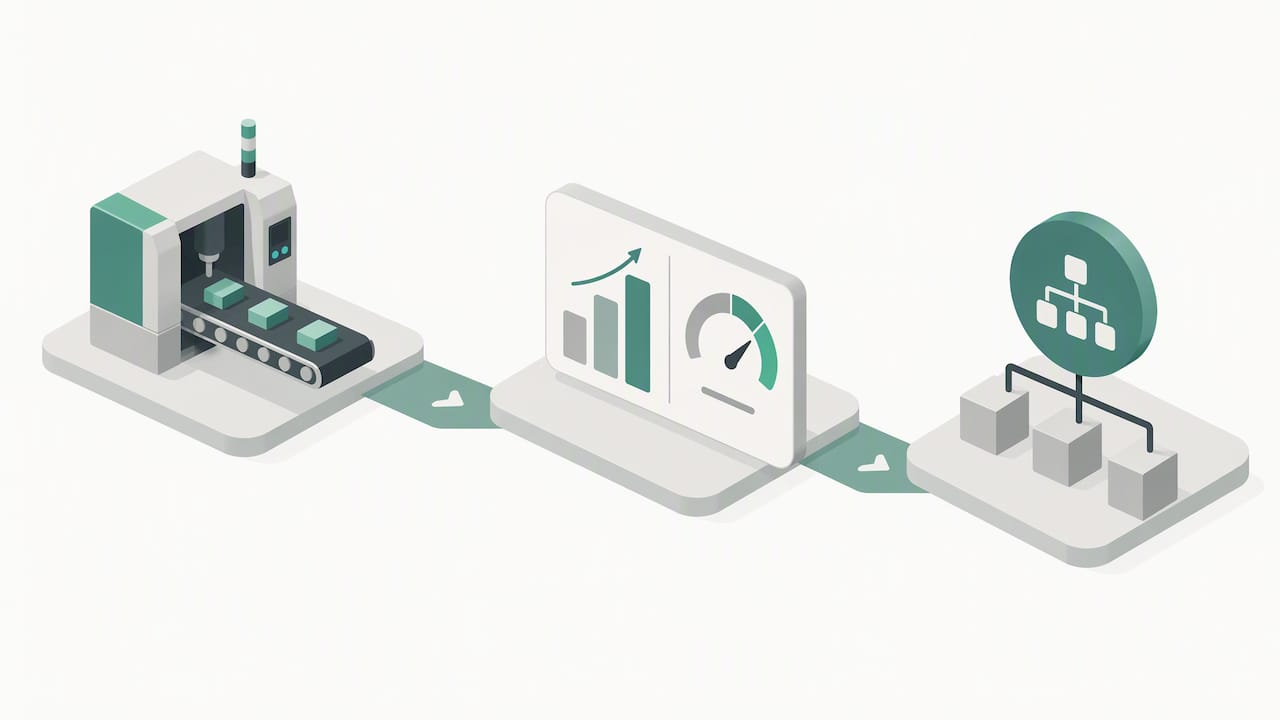
The Ministry of Economic Development, Tourism and Sport also stresses on its digitalisation page that digital transformation is more than technology. It combines software, hardware and upskilling of employees, which is why programme criteria often look at employee competences and added value per employee.
P4D 2025 attracted strong interest. SPS and the ministry approved €22.8 million in non-repayable funds for the call, and our research notes that about 450 applications led to a budget increase of €5 million. The practical lesson: have your documents ready before a call opens, and watch the SPS ePortal for budget top-ups or changes.
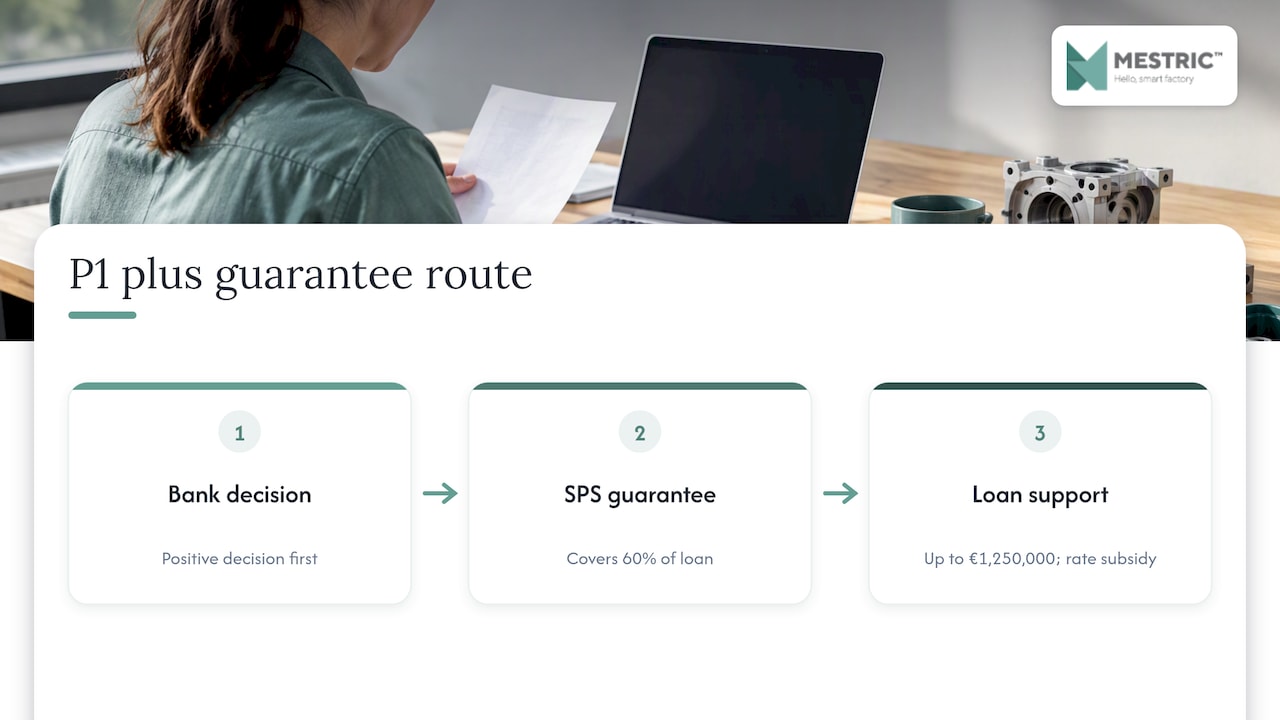
If your project is below the grant threshold, or you miss a call window, the guarantee route is worth a look. P1 plus 2026 offers SPS guarantees for bank loans with an interest-rate subsidy. The stated purpose is faster, easier and cheaper access to bank loans for micro, small and medium-sized enterprises, with emphasis on digitalisation, green transition and circular economy projects. The guarantee is 60% and the loan can reach €1,250,000.
The sequence matters. You need a positive credit decision from the bank first, and only then does the Fund guarantee the loan. In other words, your bank’s willingness to finance the project is the first validation. Prepare a business case the bank can read: payback, expected reduction in downtime and scrap, and a clear plan for the data you will collect.
Application periods in 2026 ran until mid-October, so by the time you read this the window may have closed. Check the SPS page for the next period. The official notice on GOV.SI describes the product in the public register of calls.
P2 2026 supports innovative micro and small companies developing new products, services or processes with high added value. It offers up to €72,000, released in three tranches of €12,000, €21,000 and €39,000 as milestones are met. If your company is a new innovative manufacturer, it may help. If you run an established plant with a long production history, P4D and P1 plus are the more realistic routes.
Slovenian and EU programmes often group projects under digitalisation, green transition and circular economy. The P1 plus programme names all three, and projects that show benefits across several of them can be easier to justify. Classify your project before you apply and describe each effect with a measurable KPI.
An MES can support all three:
If you want a general view of how sustainability work and revenue connect for businesses, this overview of sustainable initiatives and revenue is a short read from a commercial waste perspective in Australia. The rules it touches on are not Slovenian, so use it for ideas, not for eligibility.
A grant reviewer wants to see a project that changes how the plant works, with numbers. For an MES, build the case in this order.
A small point that saves trouble: ask every supplier to break the quote into lines that match the call’s cost categories. A single lump-sum price makes the application harder to assess.
Some industrial projects, such as extensive robotisation or a full MES roll-out across several plants, exceed the scale of standard SME schemes. Industry experts note that these can fall under other frameworks, for example individual schemes or state aid under the General Block Exemption Regulation (GBER). The Slovenian recovery and resilience plan documents, available from eu-skladi.si, show how digital transformation is organised at national level. If your investment is large, talk to the Ministry and SPS early, and take legal advice on state aid rules before you commit.
We talk to plant managers and production supervisors who want visibility on the shop floor, and the same pattern repeats. The subsidy is welcomed, but the plant gets the value only if the data is trusted by the people on the line. A grant that pays for connected machines and nothing else leaves a team with numbers they do not use.
So we suggest starting with the question the action plan asks anyway: which decision will you make differently once you see downtime, quality and cost in real time? Pick two or three such decisions. Connect the machines that matter to them first. Set the KPIs, show them on a screen the shift leader looks at every hour, and expand from there.
We also suggest that you do not choose a system because it fits a call. Choose it because it fits the plant, then check whether the cost is eligible. Funding is a way to shorten the payback, not the reason to digitalise.
— Andraž
Mestric™ MES connects directly to manufacturing equipment and shows performance, downtime, quality parameters and cost analysis in real time, with AI-powered optimisation tools. You can see the system at work in our demo centre, on connected machinery in a production environment. Read more about Mestric™ MES or get an overview of how funding fits on our page about digital transformation calls in Slovenia. Our MES has no published price, so the cost is discussed after the demonstration.
Possibly. The P4D call covered Industry 4.0 projects, data collection and visualisation, and equipment that connects machines to a platform, which are core MES functions. Eligibility depends on the specific call, your company size and the total project value, so check the current call documents.
The 2025 call offered up to €100,000 of non-repayable funds, at 50% of eligible costs. Eligible costs had to be part of a project worth more than €200,000, and the applicant needed at least 5 employees.
Check P1 plus, which gives a 60% guarantee on bank loans of up to €1,250,000 with a subsidised interest rate. You need a positive bank decision first. Also watch the SPS website for the next call, since budgets and dates change.
Usually not. P2 2026 targets new innovative micro and small companies and releases up to €72,000 in milestone-based tranches. Established plants should look at P4D and P1 plus first.


 069 763 552