

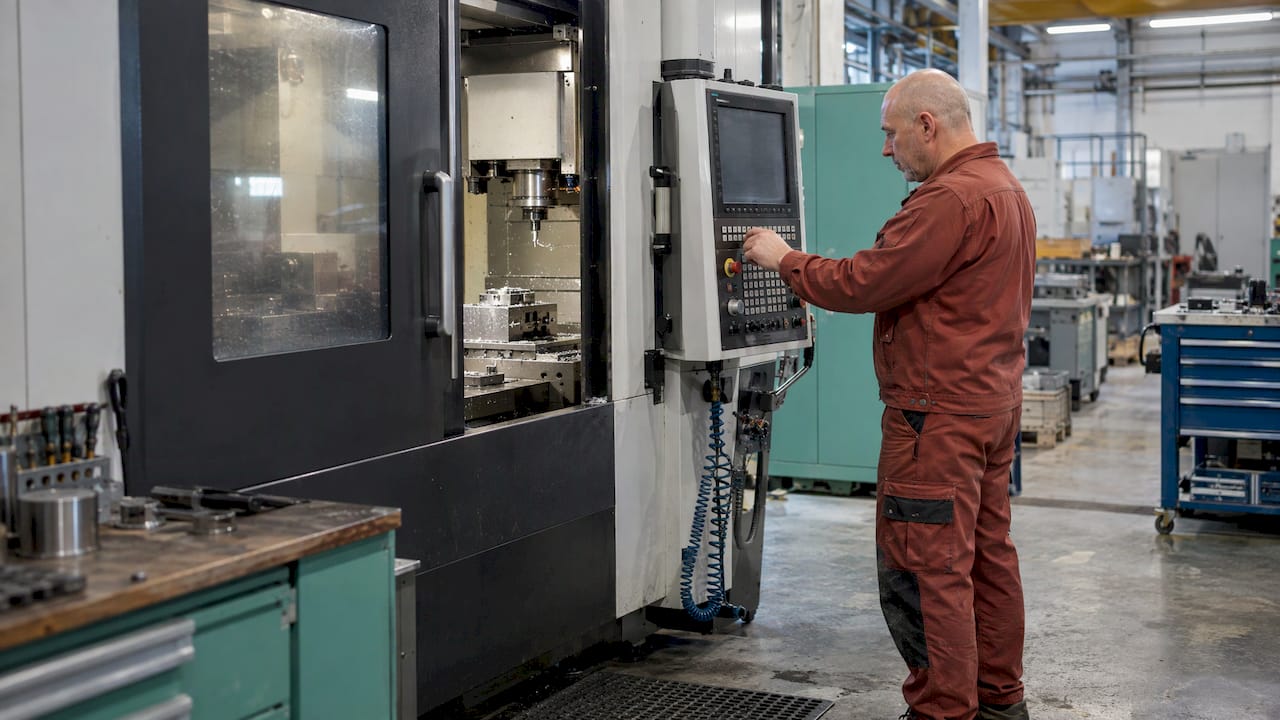
SCADA and MES are not rivals. SCADA supervises and controls equipment in real time. A Manufacturing Execution System (MES) manages production orders and turns machine data into traceability and KPIs that production managers can act on. Most plants that want both control and production insight run them side by side, with SCADA feeding data upward and MES giving it production context.
This guide is written for plant managers, production supervisors, automation engineers and the executives who sign off on factory software. It explains the difference in plain terms, shows how the two connect, and gives you criteria to decide what your plant needs.
SCADA sits close to the machines. It connects to programmable logic controllers (PLCs, the industrial computers that run a machine), sensors and other shop-floor devices. According to Automation World, it often retains their raw data records and provides supervisory controls for operators.
In practice, a SCADA screen answers questions like these:
SCADA is therefore about the state of the process and of the equipment, second by second. It is built for operators and automation engineers. Its data is raw: tags, values, alarms and trends. It does not know which customer order a batch belongs to, which operator ran the shift, or what a stoppage cost in euros.
An MES works at the level of production. It manages production orders, turns raw data into management information, and produces traceability information and performance KPIs, again as Automation World describes. An academic assessment from KTH in Sweden places MES above the shop floor in the enterprise system hierarchy: it guides, initiates, responds to and reports on production activities, passes information to other company IT systems and bridges control systems and enterprise-level information systems.
A production manager uses an MES to answer different questions:
These are the KPIs Mestric™ MES is built around: performance metrics, downtime, quality parameters and cost analysis, shown live and supported by AI-powered optimisation tools. It connects directly to manufacturing equipment, so the data is collected automatically instead of being typed in by hand. If you want to see the KPI side in more detail, our guide to production KPIs and how to select them is a good next read.
| Aspect | SCADA | MES |
|---|---|---|
| Main purpose | Supervise and control equipment and processes | Manage and report on production execution |
| Closest to | Machines, PLCs, sensors | Orders, quality, people and performance |
| Typical users | Operators, automation engineers | Production managers, supervisors, quality and operations teams |
| Data | Raw signals, alarms, trends | Management information, traceability records, KPIs |
| Timescale | Sub-second communication | Hours, shifts, days or weeks |
| Typical question | “What is this machine doing right now?” | “How did this line perform against the order and why?” |
| Control of equipment | Yes, supervisory commands | Guides and reports on production; not in direct contact with the machines |
The timescale row is the one that surprises people. According to the same Automation World article, SCADA sits at Level 2 of the Purdue Model and can communicate at sub-second rates, while MES generally focuses on hours, shifts, days or weeks. The Purdue Model is a reference layout that arranges factory systems in levels, from sensors at the bottom to business systems at the top.
You will often see a third acronym in the same discussion. ERP (Enterprise Resource Planning) handles business processes such as finance, purchasing and customer orders. It is not designed to follow what happens on a line minute by minute.
The ISA-95 standard describes how the layers connect. ISA, the international automation society, explains that it provides a framework for defining business activities and the information flow between shop-floor execution systems and ERP. It covers production planning and scheduling, maintenance, inventory control, procurement, production tracking and performance.
A simple way to hold the three together:
If you want a wider map of the software categories a plant manager meets, our overview of seven types of manufacturing software covers ERP, MES, quality management and product lifecycle management.
Integration is mainly about moving the right data upward and the right instructions downward.
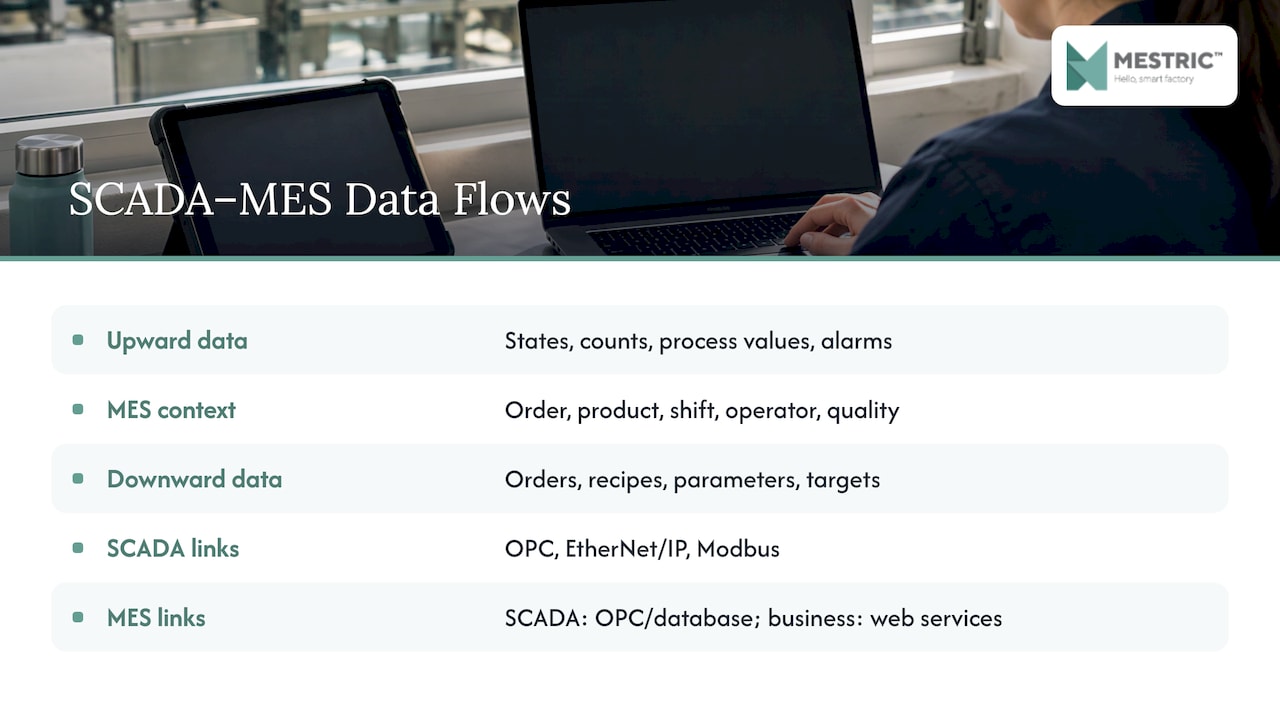
What flows up: machine states, counts, process values and alarms, collected by SCADA or directly from the equipment. MES adds the production context: order, product, shift, operator, quality result.
What flows down: production orders, recipes or parameter sets, and targets that the equipment must follow.
How they connect: SCADA uses industrial protocols such as OPC, EtherNet/IP or Modbus. MES commonly connects to SCADA through OPC or database connections and to business systems through web services and other protocols.
A documented case from Slovenia shows the pattern at scale. At Krka’s Notol pharmaceutical plant in Novo mesto, MES supervises internal transports, weighing and dosing systems, granulation, washing stations and weigh checks. The plant uses iFIX SCADA systems and a historian for data collection, with about 80 iFIX SCADA systems across 50 production islands. The two layers are integrated so they can work independently if MES becomes unavailable.
That last design point is worth copying in any plant. SCADA keeps the process under control. MES adds the order and quality logic on top. Neither becomes a single point of failure for the other.
Because SCADA needs to talk to PLCs very quickly and MES works on a longer time scale, the two are usually kept as separate layers with a defined interface between them. SCADA handles the fast loop. MES receives the data it needs at the pace production management requires. Designing the interface around that difference keeps the control layer responsive while giving managers clean, usable information.
Start from the question you cannot answer today, not from the technology.
You mainly need SCADA if:
You need MES if:
You need both if you want machines controlled precisely and the plant managed on facts. This is the usual situation in plants with several lines, regulated products or customers who ask for traceability.
Answer these five questions for your busiest line:
If you answer “no” or “it depends who you ask” to the first four, or the fifth number is above zero, the missing layer is MES. Our guide on assessing current production workflows and data takes this audit further.
Slovenian manufacturers have been combining digital investments with public support. The company Tajhmajster, for example, reports a project from May 2025 to February 2026 that introduced ERP and MES to increase productivity, traceability and data-driven decision-making. It received public funding of 93,375 EUR out of a total project cost of 235,192.46 EUR. The example shows that MES is treated as part of the digital backbone of the plant, next to ERP, rather than as an afterthought.
The benefits show up where SCADA alone cannot reach:
For a closer look at how live data changes day-to-day management, see how real-time data transforms factories.
Expecting SCADA to become MES. Adding custom reports to a SCADA project can answer some questions, but order management, traceability and KPI analysis are a different job, with different users and timescales.
Connecting everything at once. Begin with one line and the three or four KPIs that matter most, such as availability, output against plan and quality rate. Extend once the data is trusted.
Ignoring the ERP link. If orders are entered twice, once in ERP and once on the shop floor, errors return. Plan the information flow between ERP and MES using the ISA-95 logic described above.
Forgetting independence. Design the interface so the control layer keeps running if the MES layer is unavailable, as in the Krka plant.
Measuring too much. A dashboard with forty indicators is hard to act on. Pick the few measures a supervisor can influence in a shift.
Mestric™ is a subscription MES platform for factories. It connects directly with your equipment and shows production managers KPIs such as performance, downtime, quality parameters and cost analysis in real time, with AI-powered optimisation tools for process norms and quality. It supports automated data collection, workflow monitoring and shop-floor data visualisation, so your teams work from the same live picture.
You can see how this looks with real machinery through an onsite presentation at our demo centre. Read about the platform on the Mestric™ MES page or start from the Mestric home page.
If your SCADA is already in place, connecting machines to MES is the step that gives it production context. Our guide on integrating digital MES solutions with equipment describes that step in more detail.
In many plants we look at, the machines are well controlled and the management is still running on yesterday’s numbers. That is not a SCADA problem. SCADA was built to keep a process within its limits, and it does that job.
What production managers ask for is different: why did the line stop, which order is behind, what did it cost, and what can we change this shift? Those answers need production context on top of machine data. That is what an MES provides.
We built Mestric™ around that idea. It connects to your equipment, collects data automatically, and shows the KPIs that matter in real time: performance, downtime, quality and cost. Our AI-powered tools point to bottlenecks and to process norms that can be optimised, so supervisors can act while the shift is still running.
The best way to judge this is to see it on real machines. That is why we show it in a demo centre, not only on slides.
Andraž
No. SCADA supervises and controls equipment in real time and keeps raw device data. MES manages production orders and turns data into traceability information and performance KPIs. They answer different questions, for different people, on different timescales.
SCADA covers equipment supervision and control. Order execution, traceability and KPI reporting are MES tasks, and they are why most plants that want production-level insight add an MES. The two are designed to work together, not to replace each other.
SCADA talks to devices through industrial protocols such as OPC, EtherNet/IP or Modbus. MES commonly connects to SCADA through OPC or database connections, and to business systems through web services and other protocols. A well-designed link lets each layer keep working if the other is unavailable.
ERP handles business processes such as planning and purchasing. MES sits between ERP and the shop floor, executing the plan and reporting what actually happened. SCADA controls the equipment below. The ISA-95 standard describes the information flow between ERP and shop-floor execution systems.
It depends on your biggest gap. If you cannot control or see a process at machine level, start with SCADA. If machines are controlled but you lack live KPIs, downtime reasons and traceability, MES is the missing layer.


 069 763 552