

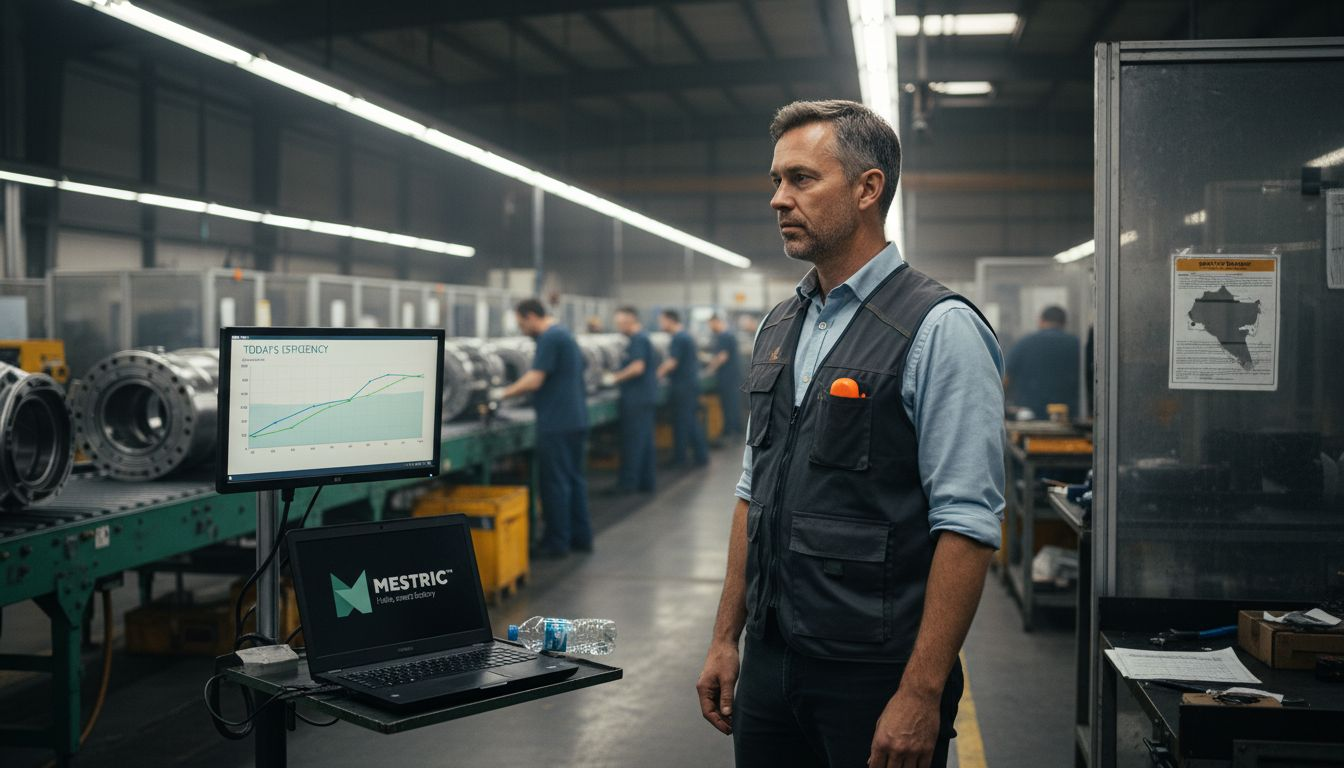
Every large-scale factory faces the challenge of balancing quality with cost as production demands keep rising. In a complex manufacturing environment, simply keeping machines busy does not guarantee true operational efficiency. For today’s managers, understanding how to achieve operational efficiency means focusing on integrating data insights and digital solutions across every plant level. This article shows how measured approaches and practical metrics can help pinpoint costly inefficiencies and unlock smarter, more responsive manufacturing.
| Punkt | Details |
|---|---|
| Operational Efficiency Definition | Operational efficiency in manufacturing involves maximising output while minimising waste and costs through an integrated approach. |
| Measurement Importance | Accurate measurement of efficiency using key performance indicators (KPIs) is crucial to identify improvement areas and track progress. |
| Integrated Approaches | Combining Lean Manufacturing, Six Sigma, and digital transformation strategies can create a more effective operational efficiency framework. |
| Management of Change | Successful digital transformation requires careful change management, including staff engagement and training to ensure new systems are adopted effectively. |
Operational efficiency in manufacturing means producing high-quality products and services whilst minimising costs and resource waste. It’s about doing more with less—getting maximum output from every machine, every worker, and every process step.
At its core, operational efficiency measures how well your facility converts inputs (materials, labour, energy) into outputs (finished goods). Think of it as the ratio between what your equipment actually produces and what it could theoretically produce at peak performance.
Manufacturers assess efficiency at different levels:
The challenge today is that operational efficiency requires integrated approaches rather than fixing isolated problems. You can’t just optimise one machine and expect overall plant performance to jump.
Real operational efficiency addresses interconnected issues like product traceability, process synchronisation, and downtime reduction simultaneously. When these elements work together, productivity gains compound.
Operational efficiency isn’t about running faster—it’s about running smarter by eliminating waste and synchronising all operations.
Many manufacturers confuse activity with efficiency. Staff staying busy doesn’t mean optimal output. True efficiency comes from reducing bottlenecks, minimising equipment downtime, and ensuring every process step flows seamlessly into the next.
Measuring efficiency properly matters too. You need concrete metrics—not just “production seems fine.” Understanding how to measure productivity against maximum capability gives you the baseline to identify improvement opportunities and track progress accurately.
The real win comes when you combine clear definitions with practical measurement. Once you know exactly where inefficiencies exist, you can systematically address them.
Pro tip: Start by measuring current performance against theoretical maximum for your three slowest production lines—this pinpoints where to focus improvement efforts first.
Manufacturers don’t use one-size-fits-all solutions for improving efficiency. Different approaches work better depending on your facility, products, and current challenges. Understanding your options helps you choose the right strategy.
The main approaches fall into three categories:
Lean Manufacturing targets waste ruthlessly. It removes unnecessary steps, reduces inventory sitting idle, and cuts material handling time. Production flows faster when you strip away non-value-adding activities. Many factories see immediate cost reductions from Lean alone.
Six Sigma takes a different angle. Instead of speed, it obsesses over consistency and quality. The methodology uses statistical analysis to identify variation in processes, then eliminates root causes. A factory with persistent quality issues often benefits most from Six Sigma.

Both Lean and Six Sigma are proven methods, yet they address different problems. Lean manufacturing techniques and Six Sigma for quality control represent complementary rather than competing approaches in modern manufacturing environments.
Digital transformation is the newer frontier. Technologies like Manufacturing Execution Systems (MES), IoT sensors, and cloud-based analytics give you real-time visibility into operations. You spot bottlenecks instantly rather than discovering them weeks later in reports.
The most effective factories combine multiple approaches—using Lean to streamline processes, Six Sigma to perfect quality, and digital tools to monitor everything continuously.
Many leading manufacturers don’t choose just one approach. They layer them strategically. One facility might start with Lean to clear obvious waste, then add Six Sigma for critical quality steps, then implement digital monitoring to sustain gains.
The combination matters because each approach has limits alone. Lean works brilliantly until you hit quality constraints. Six Sigma excels at precision but can miss waste opportunities. Digital tools require good processes to monitor in the first place.
Pro tip: Start by running a quick audit of your three slowest processes using Lean principles to identify waste, then assess whether quality consistency or real-time monitoring should be your next priority.
Here’s a comparison of the main operational efficiency approaches and where each excels:
| Ansatz | Primary Focus | Typical Applications | Limitation |
|---|---|---|---|
| Lean Manufacturing | Waste elimination | Reducing idle inventory | May overlook quality issues |
| Six Sigma | Process consistency | Minimising defects | Slower implementation |
| Digital Transformation | Real-time optimisation | Monitoring and prediction | Dependent on data accuracy |
You can’t improve what you don’t measure. Performance indicators tell you exactly where your operation stands and where problems hide. Without the right metrics, you’re flying blind.
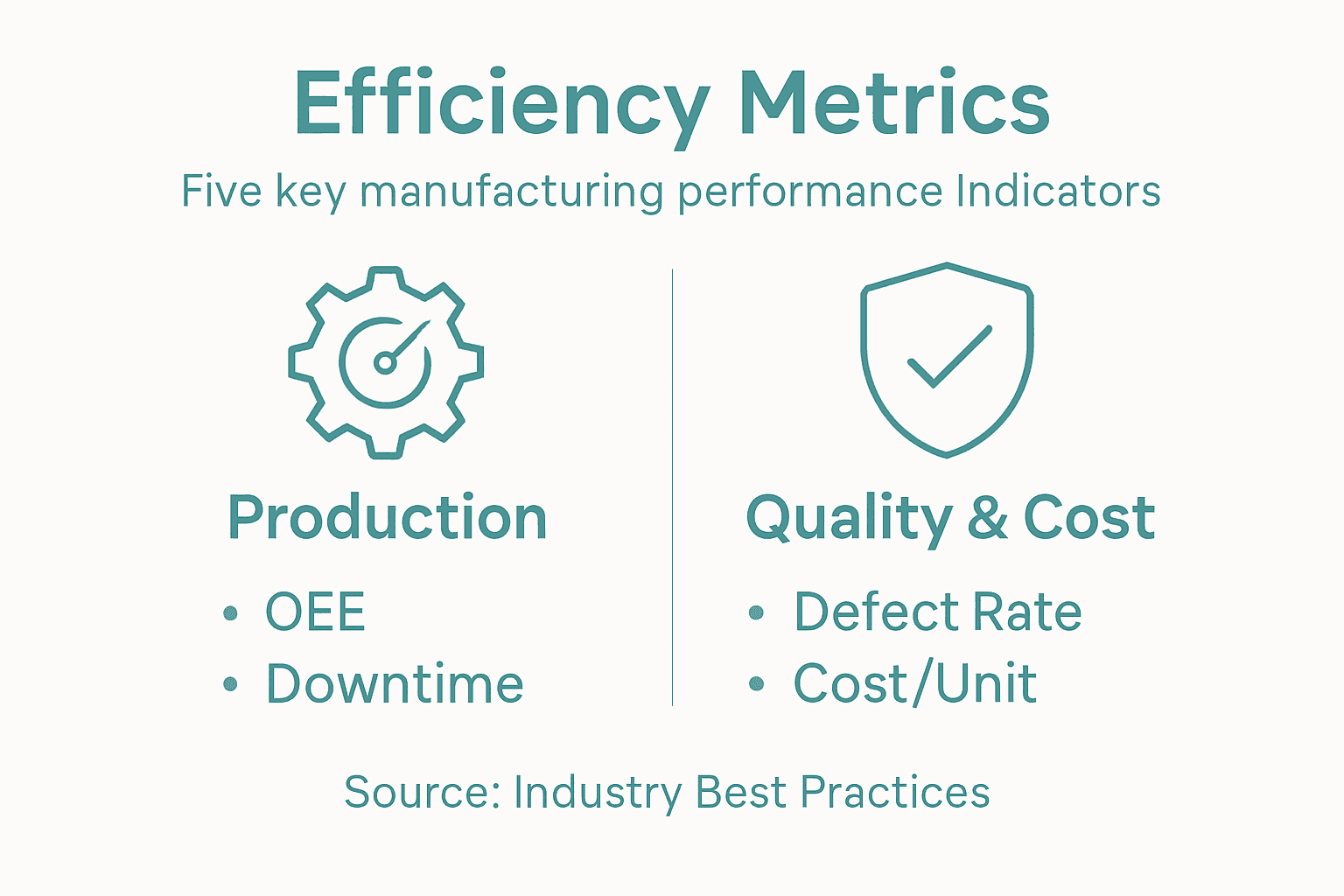
The core KPIs most manufacturers track include:
OEE deserves special attention. It measures three things simultaneously: whether equipment runs (availability), whether it runs at full speed (performance), and whether output meets standards (quality). A machine with 85% OEE means 15% of its capacity vanishes to stops, slowdowns, or scrap.
Quality metrics matter alongside speed metrics. A factory producing 1,000 units daily but scrapping 50 isn’t as efficient as one producing 950 good units. KPI selection influences operational decisions significantly across productivity, quality, and cost dimensions in ways that directly affect profitability.
Cost tracking reveals hidden inefficiencies. You track material costs obviously, but also labour hours per unit, energy consumption, and waste disposal. When these rise without output increasing, something’s wrong upstream.
The best metric isn’t the one that looks impressive—it’s the one that exposes your biggest bottleneck.
Modern operations add sustainability and flexibility metrics too. Energy consumption per unit produced, waste recycled, and changeover time between products increasingly matter to customers and regulators. These weren’t tracked five years ago but now influence competitiveness.
Many factories measure dozens of KPIs but act on none. You need critical few metrics that point toward the same goal. If production speed and quality metrics conflict, you’ve picked the wrong ones.
Real-time tracking changes everything. Historical reports showing last month’s performance help analyse trends but won’t stop today’s crisis. Systems that flag problems as they occur let you intervene before scrap piles up.
Pro tip: Focus on five core KPIs maximum—OEE, defect rate, cost per unit, downtime percentage, and one metric specific to your biggest constraint—and review them daily rather than tracking twenty metrics weekly.
The table below summarises the most impactful manufacturing KPIs and their practical business value:
| KPI | What It Measures | How It Drives Improvement |
|---|---|---|
| Overall Equipment Effectiveness (OEE) | Availability, speed, quality | Pinpoints production bottlenecks |
| Defect Rate | Proportion of faulty units | Targets areas to enhance quality |
| Cost per Unit | Direct cost for each product | Highlights savings or waste |
| Downtime Percentage | Unscheduled machine stops | Identifies need for maintenance |
| Energy per Unit | Energy use per produced item | Supports efficiency and sustainability |
Digital transformation isn’t about technology for its own sake. It’s about giving you visibility and control over operations that were previously invisible. A Manufacturing Execution System (MES) is where that transformation becomes real on the factory floor.
Traditional manufacturing relies on spreadsheets, memory, and daily stand-ups. Problems surface days or weeks later when reviewing reports. An MES changes this fundamentally by capturing data at every production step in real time.
Here’s what MES actually does:
MES works by connecting directly to your machinery and systems. Sensors feed data continuously. Software analyses patterns and flags anomalies. Managers see dashboards showing exactly where operations stand right now.
The impact is tangible. Factories using MES typically reduce unplanned downtime by 20-30% in the first year. Quality issues get caught and corrected before waste multiplies. MES platforms provide real-time monitoring, control, and optimisation of production from order start through final delivery, fundamentally changing how operators respond to problems.
Integration matters enormously. An MES sitting alone helps, but when connected with enterprise resource planning systems and shop-floor equipment, the benefits multiply. Data flows seamlessly, decisions become faster, and nothing falls through cracks.
An MES transforms manufacturing from reactive firefighting into proactive optimisation—you see problems forming and prevent them.
AI and analytics are the next frontier. Modern MES systems don’t just record what happened. They predict what will happen and recommend actions. Machine learning identifies patterns humans miss, suggesting optimal settings for equipment or flagging quality drift before defects occur.
Cybersecurity becomes critical when everything connects digitally. Protecting production data and preventing unauthorised access requires robust safeguards. This is a real consideration when planning digital transformation.
Small factories often hesitate, fearing high costs. Cloud-based MES solutions have lowered barriers significantly. You don’t need massive capital investment to start seeing benefits.
Pro tip: Begin with one critical production line—measure current performance for two weeks, implement MES there, then expand once you see measurable improvements in OEE and downtime reduction.
Digital transformation and MES implementation sound straightforward until you’re halfway through. Most factories encounter predictable obstacles that derail projects or drain budgets. Knowing what to expect helps you avoid them.
The biggest cost traps include:
Many factories underestimate integration complexity. You don’t just plug in an MES. It needs to connect with your ERP system, quality management software, and individual machines. Each connection requires custom work. Budget for this explicitly—it’s often 40% of total project cost.
Staff resistance is real and dangerous. Operators worry about job security. Managers fear losing authority to algorithms. Without genuine engagement from the floor up, adoption stalls. Workers will find ways to bypass systems they don’t trust.
Data quality becomes critical immediately. Garbage in, garbage out. If your baseline data is inaccurate—machines misconfigured, historical records incomplete—the MES amplifies those errors. Cybersecurity challenges and system integration complexities emerge when attempting to synchronise production data across platforms and protect sensitive information from unauthorised access.
The costliest MES failures aren’t technical—they’re organisational. Systems fail when people don’t believe in them.
Overambitious scope kills projects too. Trying to optimise everything simultaneously stretches budgets and timelines. Start small. Prove value on one line or process, then expand methodically.
Cybersecurity risks multiply when you connect everything. More data flowing means more exposure. Protecting production information and preventing system compromise requires investment in security infrastructure that wasn’t necessary before.
Vendor lock-in is another concern. Some MES platforms make switching costs prohibitive later. Proprietary data formats, closed APIs, and long-term contracts can trap you with poor service or outdated technology.
Realise that change management takes as long as technical implementation. If your project timeline is twelve months, allocate six months for adoption and adaptation. People need time to trust new systems.
Pro tip: Build a detailed cost model including software, hardware, integration, training, and disruption costs—then add 25% contingency, because every factory faces unexpected integration challenges during implementation.
The challenges of achieving true operational efficiency in manufacturing centre on eliminating bottlenecks, reducing downtime, and synchronising all operations for smarter production. If improving your facility’s Overall Equipment Effectiveness and quality metrics feels overwhelming, real-time performance tracking is essential. Mestric™ offers a user-friendly Manufacturing Execution System that connects directly to your equipment, providing instant visibility into key indicators like downtime percentage, defect rate, and cost per unit. This lets you identify problems before they escalate and take proactive steps to increase efficiency and reduce waste.
Explore practical strategies for operational excellence in our Lernen - Mestric section and discover how digital transformation can finally bring your manufacturing processes into the modern age.
Take control of your production line today. Visit Mestric™ to see how integrating our MES platform can transform your operations with real-time analytics, AI-powered optimisation, and increased productivity. Don’t let inefficiencies hold you back. Start your journey towards streamlined manufacturing now.
Operational efficiency in manufacturing refers to the ability to produce high-quality products while minimising costs and reducing resource waste. It’s about achieving maximum output from all resources, including machines and personnel.
Manufacturers can measure operational efficiency using metrics such as Overall Equipment Effectiveness (OEE), production volume, downtime percentage, defect rate, and cost per unit, providing a clear view of performance against maximum capability.
The main approaches to improving operational efficiency include Lean Manufacturing, which focuses on waste elimination; Six Sigma, which emphasises quality control; and Digital Transformation, which leverages technology for real-time optimisation.
Real-time monitoring enables immediate visibility into production processes, allowing manufacturers to identify and address bottlenecks and quality issues as they happen, ultimately reducing downtime and optimising overall operations.


 069 763 552