

AI production scheduling takes your orders, routings, materials, machine and labour capacity and due dates, builds a feasible schedule, and recalculates it when something changes. It does not replace your planner. It gives the planner a faster, better-informed starting point. This guide explains how it works, what data it needs, what results plants have reported, and how to begin without risking your shop floor.
AI production scheduling combines orders, routings, materials, machine and labour capacity, changeovers and due dates to produce a feasible schedule. When conditions change, it recalculates. Traditional planning often works from a snapshot, while AI can compare alternatives and react to late materials, rush orders, machine failures or absences, as described in a 2026 overview of AI in planning and scheduling.
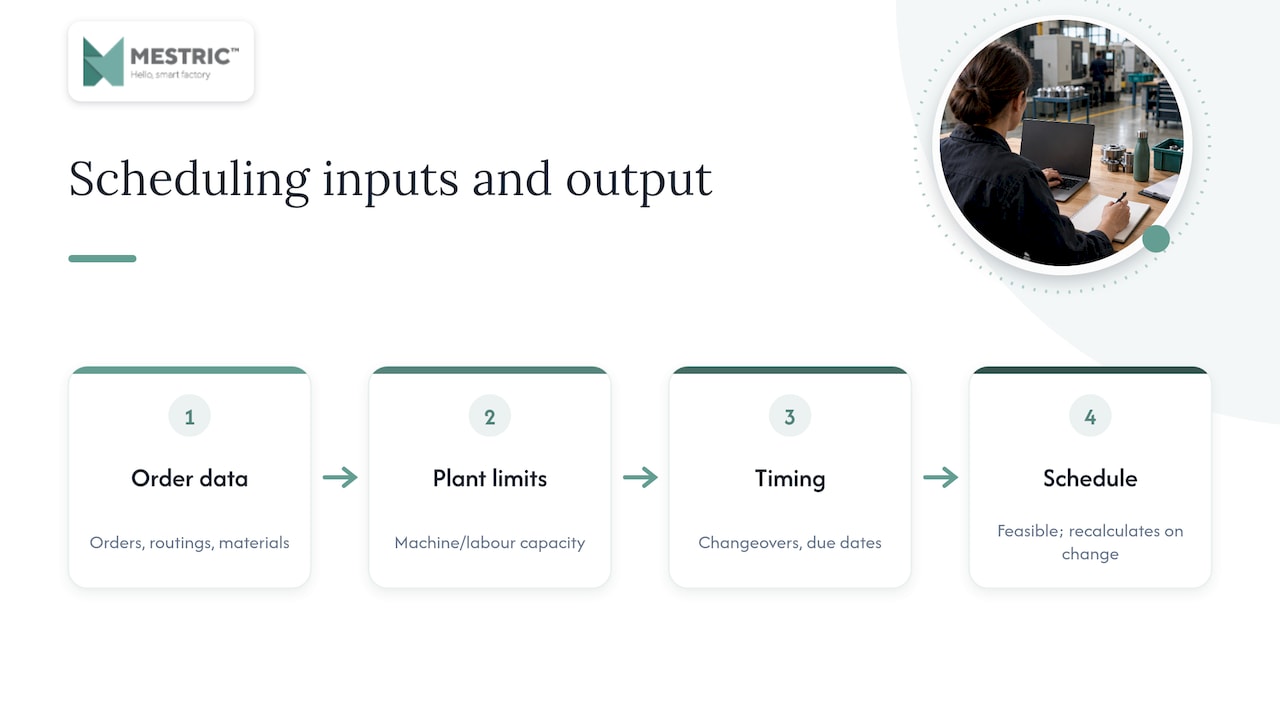
It helps to place scheduling in the planning hierarchy. A Slovenian academic paper on AI in production planning describes four planning processes: strategic, annual, monthly and micro-planning. Scheduling sits at the lowest level, micro-planning. This is where orders are assigned to machines in a sequence, hour by hour and shift by shift. It is also where small errors cost the most, because every missed changeover or late material shows up on the floor the same day.
The same paper explains that AI lets a production system use machine learning to analyse its own production environment and adapt to new conditions. In practice that means the schedule is no longer a document you print in the morning. It is a model that keeps learning how your plant really behaves.
Many plants still schedule in spreadsheets or with fixed rules: forward and backward scheduling, priority lists, the experience of one or two key people. These methods work until several goals compete at once.
According to Evertiq, citing an electronics manufacturer, the biggest difference is the ability to balance several conflicting objectives dynamically. Fixed rules and sequential logic reach their limits when you must optimise several KPIs at the same time. The same source notes that if the market shifts and on-time delivery becomes more important than maximum utilisation, an AI-supported system can re-weight its priorities. A fixed heuristic cannot.
The planner’s role changes too. As an interview in Digital Manufacturing puts it, the planner moves from reactive disruption manager to strategic decision-maker who evaluates AI suggestions and prioritises goals.
| Aspect | Traditional scheduling | AI-supported scheduling |
|---|---|---|
| Basis | Snapshot, fixed rules, experience | Continuous data from production, purchasing and logistics |
| Reaction to disruption | Manual rework by the planner | Automatic recalculation, alternatives compared |
| Competing goals | Hard to balance | Weighted and re-weighted as priorities change |
| Planner’s role | Disruption manager | Evaluates suggestions, sets priorities |
| Duration estimates | Master-data norms | Learned from historical execution |
A scheduling model is only as good as its inputs. In the Slovenian case study published in MDPI Processes, AI-based advanced planning and scheduling takes production orders from the ERP system when the desired finish date is still two weeks away. It then does two things: it schedules all orders on machines in the optimum sequence, and it predicts the duration of each order. The predictions come from machine learning algorithms trained on historical data from the MES database, together with target durations from the ERP.
From that, a practical data checklist follows:
That last point matters. The authors of the MDPI study conclude that AI in scheduling makes sense only if it has access to all relevant data about random and unexpected events that influence the real duration of orders, not just data about actual realisation. If your system records that an order took nine hours but not why, the model cannot learn the difference between a slow machine and a missing pallet.
This is why automated data capture from machines is the foundation. If operators type times into a terminal at the end of a shift, the data is late and often rounded. If machines report directly, the scheduler sees what really happened. Our guide to integrating a digital MES with equipment covers this step in more detail, and assessing current workflows and data is the right place to begin.
The logic follows a repeating loop.
A second Slovenian paper, on operational planning at Domel, describes the same idea. The AI predicts the future realisation of production orders, adjusts its predictive algorithms to match the actual state better, learns optimal sequences and builds them into the schedule on machines.
Digital twins add another layer. The GOSTOP programme describes a demonstrator that lets manufacturers test resource and plan changes virtually, predict delays and quantify the effect on OEE before changing anything on the shop floor. It connects ERP, MES, PLC and IoT systems and uses a statistical digital twin, a capacity model, historical learning and what-if analysis.
For a deeper look at how replanning works in a pilot setting, see our 90-day pilot for dynamic production replanning.
Published results vary by plant, product mix and starting point. They show a direction, not a guarantee for your factory.
Notice what these have in common. In each case scheduling was connected to ERP and execution data. The gains come from the whole loop, not from an algorithm on its own.
Good scheduling projects name their risks early. The evidence points to a few.
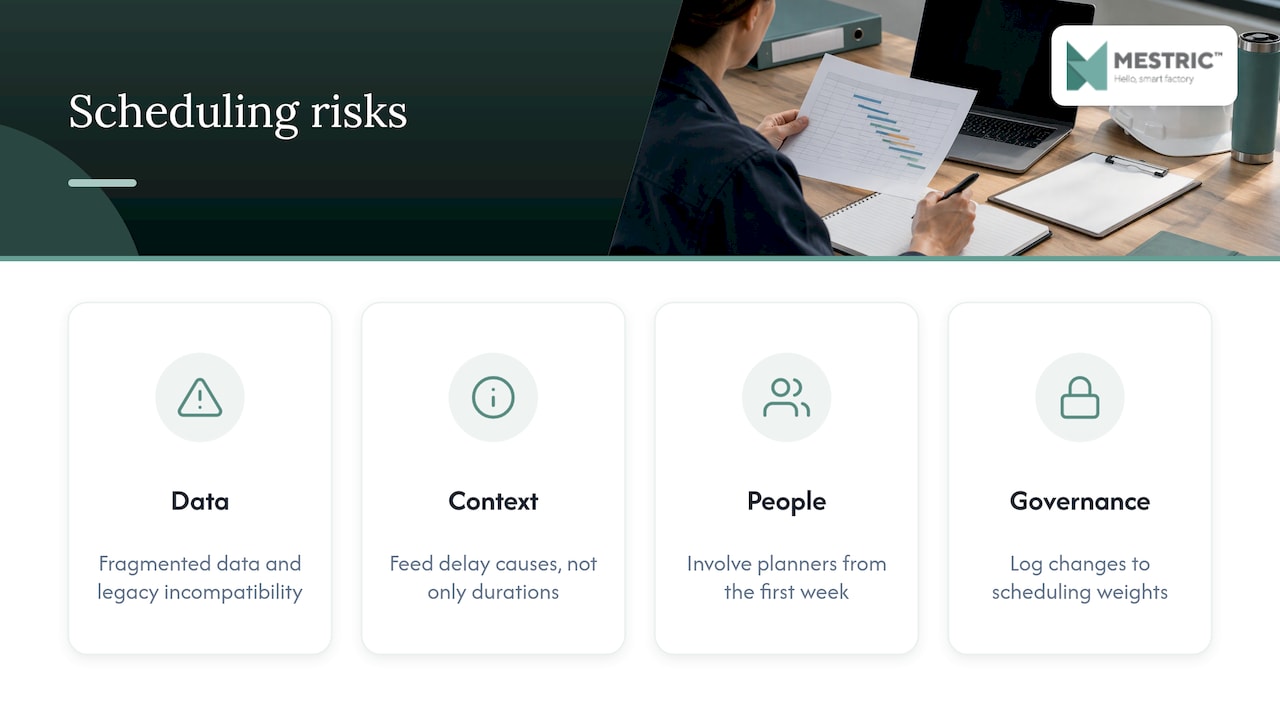
Data quality. A review in Scientific Reports lists legacy-system incompatibility, fragmented and inconsistent data, interoperability problems, workforce resistance, skills shortages, cybersecurity, cost and uncertain ROI as barriers to AI-enabled smart production. Most of these are solved by preparation, not by a different algorithm.
Missing context. In the Slovenian MDPI study, published in October 2024, actual realisation was on average closer to the master-data plan than to the AI prediction. The authors read this as a sign that the model needs richer data about unexpected events. The practical lesson: feed the model causes of delay, not only durations, and keep an experienced planner in the loop. The study describes AI as a valuable assistant rather than a replacement for the planner.
People. Planners who have kept the plant running for years will rightly ask how the system reaches its suggestions. Involve them from the first week. Let them accept, adjust or reject proposals, and use their corrections as learning data.
Security and governance. Decide who owns the data, who can change scheduling weights and how changes are logged. Our guide to a secure MES rollout shows how pilot, readiness and hypercare phases fit together.
The Slovenian Chamber of Commerce AI4SI guide for SMEs recommends starting with a small pilot, collecting feedback, demonstrating business value, and only then industrialising with defined infrastructure, responsibilities and management commitment. A pilot is a way to learn and set up governance, not only to test technology.
A workable plan for a scheduling pilot:
If you want to see how AI fits the wider workflow, read how to optimise production workflow with AI and our overview of the role of AI in manufacturing.
We see the same pattern in many plants: the schedule is good on Monday morning and out of date by Monday afternoon. The reason is rarely the planner. It is that the plan and the shop floor do not share live data.
That is why we start from the shop floor. Mestric™ connects directly to manufacturing equipment, collects data automatically and shows production managers KPIs such as performance, downtime, quality parameters and cost analysis in real time. Our AI-powered optimisation tools build on that foundation to help identify bottlenecks, reduce manual errors and support decisions.
We believe a scheduling tool earns trust when planners can see why a proposal makes sense. Real-time visibility of machine status, stoppages and quality gives them that. It also gives any AI model the context it needs, including the causes of delays, which the research above shows is essential.
Our advice: get the data capture right first, then optimise the sequence. A schedule built on accurate, automatic data is one your team will actually follow.
Andraž
Mestric™ is a Manufacturing Execution System with real-time performance tracking, quality monitoring, downtime analysis, cost analytics and AI-powered optimisation tools. It connects to your machines so schedule decisions rest on what is actually happening. You can see connected machinery at work through an onsite presentation in our demo centre.
Read more about Mestric™ MES and how it supports planners, or explore Echtzeit-Produktionsüberwachung to see the data layer a scheduler depends on.
To judge whether AI scheduling is helping, watch a small set of numbers:
Our productivity analytics guide explains how to turn these into a routine review, and the real-time KPI tracking step shows how to automate it.
No. The Slovenian MDPI study describes AI as a valuable assistant rather than a replacement. The planner moves from firefighting to evaluating proposals and setting priorities, such as whether on-time delivery or utilisation matters more this quarter.
In the Slovenian examples above, scheduling draws orders from the ERP and execution history from the MES. Having both gives the model the orders it must plan and the real durations it should learn from. Direct machine connection makes that execution data more accurate.
The AI4SI guide recommends a small pilot, followed by feedback, proof of business value and then industrialisation. Our own pilot format runs over 90 days for dynamic replanning, with KPIs defined at the start. Your timeline depends on how ready your data is.
No. The AI4SI guide is written for small and medium enterprises and recommends starting small. A single line with clear scheduling problems is a sensible first scope, whatever the size of the company.
Published cases report faster schedule creation, higher on-time delivery and less congestion, but they come from different companies and conditions. Set your own baseline and targets for one line, then measure against them.


 069 763 552