


TL;DR:
- Intelligent manufacturing integrates people, processes, machines, and data into a unified system to optimize quality, speed, and cost. Its success depends on modular architecture, shared data foundations, and robust security tailored to operational technology environments. When properly deployed, it delivers measurable improvements in efficiency, predictive maintenance, and energy use across multiple facilities.
Most manufacturing professionals understand that digital technology is reshaping production. Fewer understand that intelligent manufacturing is not simply a collection of tools bolted onto existing processes. It is an integrated system of people, processes, machines, and data working together to optimise quality, speed, and cost simultaneously. This article breaks down how intelligent manufacturing systems actually work, covering architecture, AI integration, operational benefits, and the governance considerations that determine whether these deployments succeed or stall.
| Point | Details |
|---|---|
| Integrated, not isolated | Intelligent manufacturing combines sensing, data processing, AI inference, and actuation into one continuous system. |
| Architecture matters first | Frameworks like RAMI 4.0 help you sequence technology adoption modularly and avoid fragmentation. |
| AI needs infrastructure, not pilots | Scaling AI beyond one plant requires shared data foundations, governance, and clear KPIs across sites. |
| Operational gains are measurable | Organisations report 10–20% production output gains and significant reductions in unplanned downtime. |
| Security is not optional | OT environments require tailored cybersecurity controls that differ fundamentally from standard IT approaches. |
Understanding intelligent manufacturing systems explained properly means starting with what actually powers them. These are not monolithic platforms. They are layered architectures connecting the physical world to digital decision-making.
At their core, intelligent systems follow a sense, process, infer, and actuate pipeline. Sensors on equipment capture raw data: vibration, temperature, pressure, flow rates. That data moves to processing layers where it is filtered, contextualised, and fed into inference models. The output drives actuation. Machines adjust parameters, alerts fire, schedules change. This happens in real time rather than through fixed programmatic sequences, which is what separates intelligent systems from traditional automation.
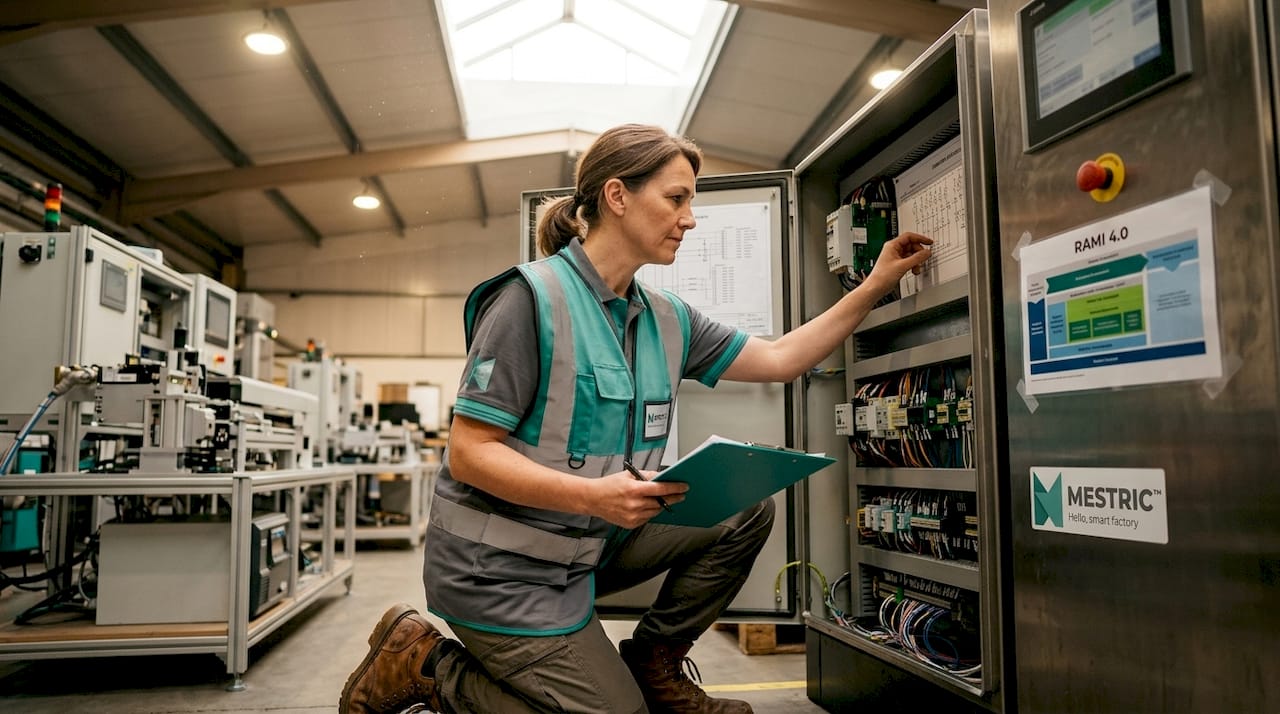
For decision-makers mapping how to adopt these technologies without creating fragmentation, the RAMI 4.0 reference architecture provides a practical organising structure. It operates across three dimensions: automation hierarchy levels (from field devices up to connected world), product lifecycle stages (from design through decommissioning), and functional layers (from the physical asset layer up through information, communication, integration, and business layers).
The value of this framework is that it forces a modular, layered approach. You do not connect everything at once. You map where your current systems sit, identify gaps, and sequence integration deliberately. Manufacturers who skip this step frequently end up with technology fragmentation where IoT devices generate data that no system can act on coherently.
| Layer | Function | Example technologies |
|---|---|---|
| Physical | Sensing and actuation at machine level | PLCs, sensors, actuators |
| Communication | Real-time data transmission | OPC-UA, MQTT, industrial Ethernet |
| Integration | Connecting systems and enabling interoperability | MES, SCADA, API middleware |
| Information | Data storage, contextualisation, and analytics | Data historians, cloud databases |
| Business | Decision support and enterprise coordination | ERP, AI dashboards, reporting tools |
IoT sits across multiple layers, while cloud infrastructure supports the information and business layers specifically. Understanding which technologies belong at which layer helps you prioritise investment and avoid buying tools that solve problems you do not yet have.
There is a pattern that plays out repeatedly in manufacturing organisations. A team proves that an AI model works in one plant. Leadership celebrates. Then someone asks: how do we replicate this across twelve sites? The answer, if data foundations and governance are not in place, is usually: we cannot.
Accenture’s concept of systemic AI as closed-loop infrastructure addresses this directly. Systemic AI treats artificial intelligence not as a series of individual projects but as a continuously operating capability. The cycle runs as follows: sense conditions across the operation, decide using models trained on shared data, execute across physical and digital systems, and learn by feeding outcomes back into the models. This loop does not stop after one deployment.
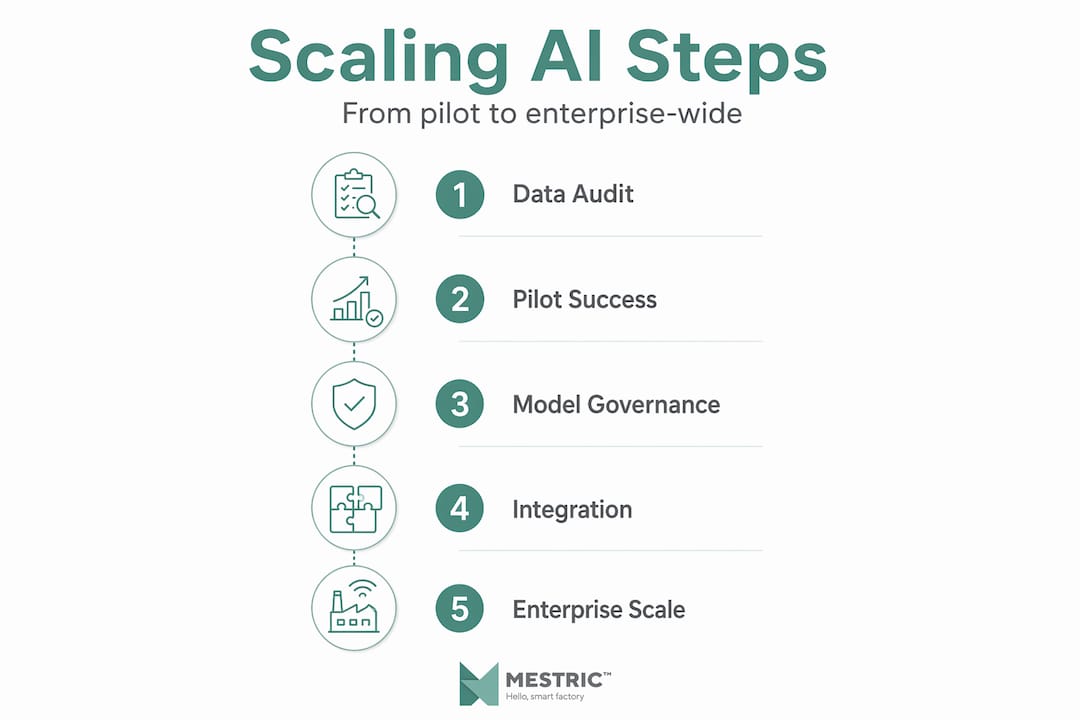
Organisations that successfully scale AI across multiple plants tend to invest in five specific areas:
Stalling on data silos is the most common reason intelligent manufacturing initiatives fail to deliver enterprise-wide value. The technology is rarely the limiting factor. Data access and governance almost always are.
Pro Tip: Before deploying any AI model to production, conduct a data audit across every plant you intend to scale to. Identify which data sources are siloed, which are accessible in real time, and which require engineering to standardise. This audit will surface the actual constraints on your AI programme far earlier than a pilot will.
Understanding the role of AI in manufacturing efficiency in detail can help you assess where your organisation sits on this maturity curve and what to prioritise next.
When intelligent manufacturing systems are correctly integrated, the performance improvements are concrete and measurable. Connected machines and sensors stream data to central dashboards, enabling early deviation detection and predictive quality control before defects reach the end of the production line.
Here are the key operational applications where these systems deliver the most consistent results:
Predictive maintenance: Sensors monitoring vibration, temperature, and acoustic signatures feed anomaly detection models that estimate the remaining useful life of motors, pumps, and rotating equipment. Unplanned downtime reductions of up to 50% are achievable compared with time-based maintenance schedules.
Automated visual inspection: Machine vision systems running inference models detect surface defects, dimensional variances, and assembly errors at speeds no human inspector can match consistently, and they do so without fatigue.
Adaptive process control: Real-time sensor feedback adjusts machine parameters mid-cycle. In injection moulding, for example, temperature and pressure values update automatically based on material batch properties, reducing scrap rates without operator intervention.
Dynamic scheduling: AI models recalculate production schedules when machines go offline, orders change, or material availability shifts. This removes the lag between disruption and response that costs manufacturers hours of productive output.
Energy optimisation: Intelligent systems identify when equipment runs above required capacity and adjust operating parameters, reducing energy consumption per unit produced without affecting throughput.
Organisations adopting these capabilities report output gains of 10 to 20% in production and up to 20% in employee productivity, driven primarily by the reduction of manual data collection, unplanned stoppages, and reactive decision-making. The efficiency gains compound once adaptive control and predictive maintenance operate together across a connected production environment.
You can explore how connected machinery benefits your specific production environment to understand which applications are likely to deliver the fastest return in your context.
Connecting operational technology to enterprise networks and cloud platforms creates capability. It also creates exposure. OT environments have security requirements that are fundamentally different from standard IT environments, and treating them the same is one of the most common mistakes in intelligent manufacturing deployments.
The core distinction is priority. OT systems prioritise availability and safety over confidentiality. A production line cannot be taken offline for a patch cycle the way an office server can. A SCADA system controlling a chemical process cannot tolerate latency introduced by security scanning tools. These constraints require purpose-built controls.
NIST SP 800-82 Rev. 3 provides the most widely referenced guidance for OT cybersecurity in industrial environments. Its key recommendations include zone and conduit network segmentation, multi-factor authentication for all remote access, and OT-specific incident response plans that account for safety requirements and production continuity rather than just data protection.
Early integration of OT security measures based on NIST SP 800-82 is critical because components like SCADA, PLCs, and engineering workstations have unique safety and availability constraints that are difficult to retrofit security controls around after deployment.
Network segmentation deserves particular attention. Separating the field device network from the plant operations network, and separating both from the enterprise network, limits the blast radius of any intrusion. Access controls at conduit boundaries and strict change management for PLC configurations reduce the attack surface substantially without requiring full system redesign.
Pro Tip: Involve your OT security team in the architecture design stage, not after it. Security controls that are retrofitted onto intelligent manufacturing deployments are always more expensive, more disruptive, and less effective than those built in from the start. Treat security as a design requirement, not a final checklist item.
I have observed enough intelligent manufacturing deployments to say with confidence that the technology is rarely what determines success or failure. What determines it is whether the organisation treats intelligent manufacturing as a continuous operational practice or as a finite project with a completion date.
In my experience, the facilities that extract lasting value from these systems are the ones that start with a production data audit, not a technology procurement exercise. They map what data they already have, where it is locked, and which decisions it could inform. That foundation shapes every technology choice that follows.
The challenge of data silos is real and underestimated. I have seen organisations deploy sophisticated AI models that work brilliantly in isolation and then stall entirely when someone asks for the output to feed into an ERP or coordinate across two plants running different historians. The integration work is unglamorous, but it is the work that actually determines whether intelligent manufacturing creates enterprise value or just impressive demonstrations.
What I find most encouraging is the shift in how leading manufacturers are framing human roles. The best implementations are not about replacing operators. They are about giving operators and engineers better information faster. A production manager who sees a quality deviation on a dashboard before it becomes a defect batch is making a decision. The system just gave them the right data at the right moment. That framing makes adoption easier, governance clearer, and outcomes more sustainable.
— Andraž
If you are working through the practicalities of intelligent manufacturing adoption, Mestric provides a Manufacturing Execution System built specifically for production teams who need real-time visibility without the complexity of enterprise platforms.
Mestric connects directly to your manufacturing equipment, giving production managers live KPIs covering performance metrics, downtime, quality parameters, and cost analysis, all integrated with AI-powered optimisation tools. It identifies bottlenecks, reduces manual errors, and supports the kind of informed, data-driven decisions that intelligent manufacturing depends on.
For decision-makers assessing where a modern MES fits into their broader intelligent manufacturing strategy, Mestric offers onsite demonstrations to show exactly how connected machinery benefits your specific production environment. The types of manufacturing software available in 2026 vary significantly in scope and depth. Mestric is designed for teams who want operational clarity from day one.
Intelligent manufacturing is an integrated approach that connects people, machines, data, and processes to optimise quality, speed, and cost simultaneously. It relies on real-time sensing, AI-driven inference, and closed-loop feedback rather than fixed automation sequences.
The core components are sensing (IoT devices and industrial sensors), data processing (historians, edge computing, cloud platforms), AI inference (machine learning models), and actuation (automated control systems and decision support tools). Architectural frameworks like RAMI 4.0 help organise how these components connect.
Systemic AI treats artificial intelligence as shared infrastructure with governance, KPIs, and data foundations built to operate across multiple sites. An isolated pilot proves a model works locally but does not generate repeatable, scalable value without that broader infrastructure in place.
NIST SP 800-82 Rev. 3 provides OT-specific cybersecurity guidance covering network segmentation, multi-factor authentication, and incident response planning tailored to industrial control systems, where availability and safety take priority over confidentiality.
Organisations adopting intelligent manufacturing systems report production output gains of 10 to 20%, employee productivity improvements of up to 20%, and reductions in unplanned downtime of up to 50% through predictive maintenance programmes.


 069 763 552