


TL;DR:
- Outdated workflows reduce manufacturing efficiency, quality, and margins daily.
- A structured, digital-first approach enhances visibility, measurement, analysis, and control.
- Continuous improvement with frameworks like Six Sigma and digital tools sustains gains over time.
Outdated workflows are quietly draining output, quality, and margin from manufacturing plants every day. When processes are built on ad hoc decisions and manual handoffs, even experienced teams struggle to hit targets consistently. The good news is that a structured, digital-first approach changes this entirely. This guide walks you through each critical stage of a modern manufacturing workflow, from baseline analysis to sustained improvement. You will learn which steps matter most, how to apply proven frameworks like Six Sigma, what KPIs to track, and how digital tools convert process data into measurable gains.
| Point | Details |
|---|---|
| Stepwise process is essential | Following a defined workflow exposes problems and enables effective automation. |
| DMAIC and KPIs fuel improvement | Benchmarks such as OEE and Six Sigma enable targeted, data-driven optimisation. |
| Start digital transformation carefully | Piloting digital tools on well-mapped tasks gives better ROI and prevents costly mistakes. |
| Continuous monitoring sustains gains | Routine verification and team engagement are key for lasting workflow improvements. |
With the challenge clear, it is important to understand what foundations successful workflow transformation requires. Jumping straight into changes without preparation leads to patchy results and wasted effort.
Start by clarifying your objectives and securing stakeholder buy-in. Operations leaders and executives need to agree on what success looks like before any process changes begin. Without that alignment, even the best tools deliver mixed results.
Next, collect your baseline data. You need reliable figures for cycle time, defect rates, and throughput before you can measure improvement. A standard step-by-step workflow includes mapping current processes, assessing this data, and then implementing the right digital tools in sequence.
Here is a comparison of where most manufacturers start versus a digital-first foundation:
| Dimension | Traditional approach | Digital-first approach |
|---|---|---|
| Process visibility | Manual observation | Real-time dashboards |
| Data collection | Paper or spreadsheet | Automated sensor feeds |
| Error detection | After the fact | Live alerts |
| Reporting | Weekly or monthly | Continuous |
| Scalability | Limited | High |
The tools you need at this stage include process mapping software, a real-time monitoring platform, and digital quality checklists. Understanding how workflow efficiency with MES differs from traditional methods will also help you prioritise your digital investments.
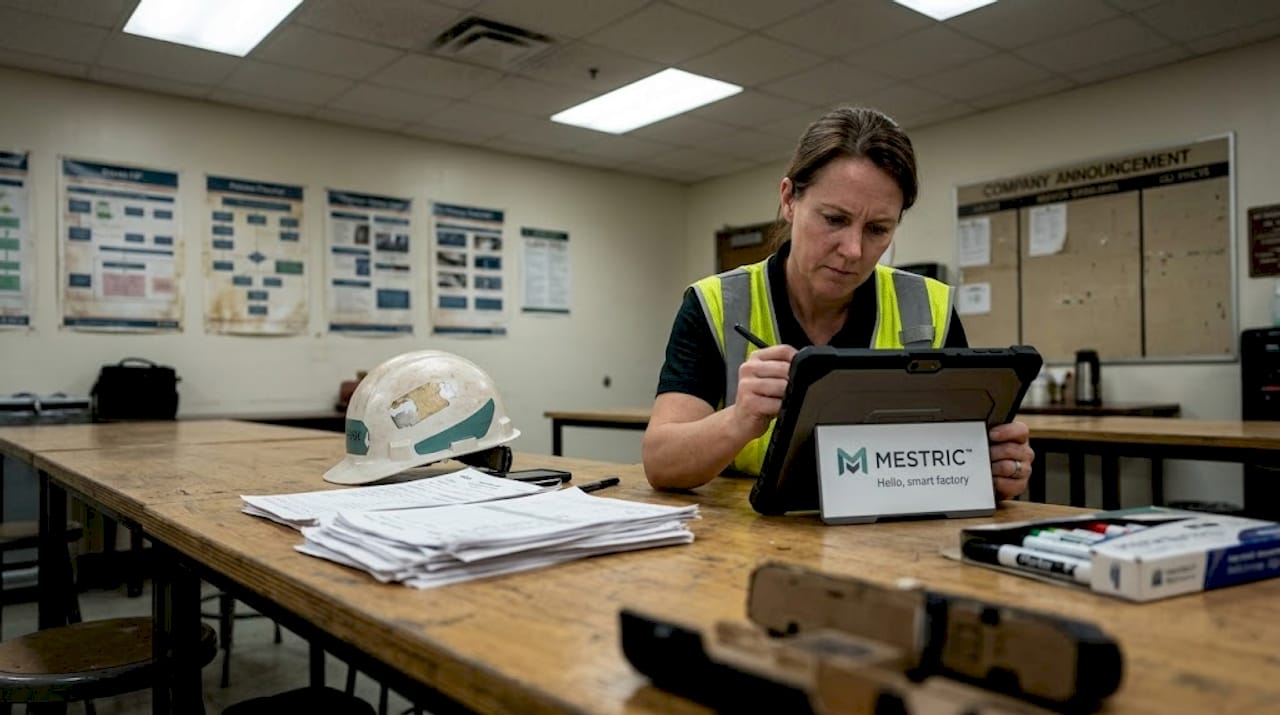
For safety-critical environments, ensure your workflow safety considerations are integrated into your process map from the outset, not added as an afterthought.
Pro Tip: Digitally mapping your current workflow before making any changes prevents blind spots from forming in later improvement steps. What you cannot see, you cannot fix.
Once prerequisites are assembled, you can proceed step by step to overhaul your workflow. A methodical sequence keeps teams focused and prevents costly rework.
A standard approach follows the sequence: map, measure, monitor, optimise, and control. That structure is not arbitrary. Each step builds on the last.
| Stage | Primary tools | Key deliverable |
|---|---|---|
| Define | Workshop, SIPOC diagram | Clear scope document |
| Map | Process mapping software | Visual workflow map |
| Measure | MES, sensors, ERP data | Baseline KPI report |
| Analyse | Process mining, Pareto charts | Bottleneck analysis |
| Improve | Automation, revised SOPs | Updated workflow |
| Control | Real-time monitoring, audits | Control plan |
Bottlenecks are most commonly found in the measurement and analysis stages, where data gaps or manual processes obscure what is really happening. Your production optimisation guide can help you navigate this phase, and reviewing a process improvement guide will support your team during the improve and control steps.
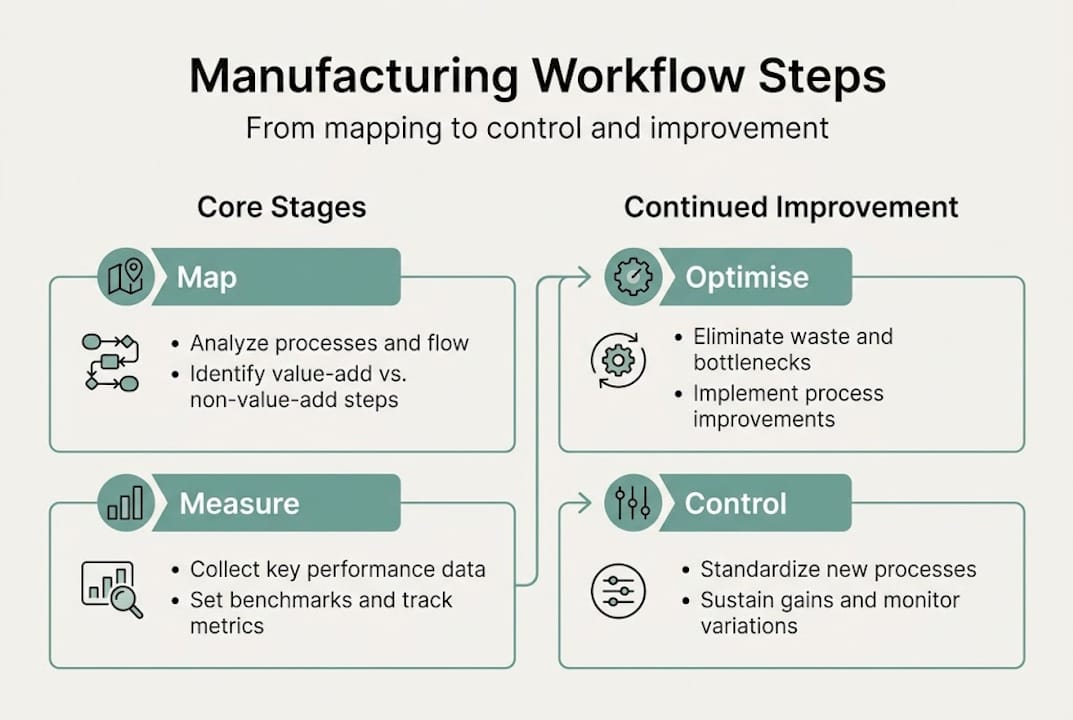
Pro Tip: For each stage, define one specific, actionable deliverable. Theory without output moves nothing forward.
With clearly defined workflow steps, the next layer is quantifying and benchmarking improvements. Frameworks and benchmarks turn intuition into evidence.
The DMAIC framework from Six Sigma structures every improvement project:
“DMAIC can reduce defects by up to 60% per project, advancing sigma performance and delivering sustained quality improvement.”
DMAIC consistently reduces defects by 40 to 60% and raises sigma levels across manufacturing environments. That is not a marginal gain. It reshapes quality performance.
OEE (Overall Equipment Effectiveness) is your most reliable single metric for plant health. World-class OEE sits at 85% or above, while industry averages typically range from 55 to 60%. If your OEE is below 65%, there are significant, recoverable gains available to you right now.
Critical KPIs to track alongside OEE include:
Sector-specific median KPIs from APQC provide a reliable external benchmark for your performance targets. Use the optimisation checklist to structure your KPI tracking, and explore process optimisation methods that fit your plant’s specific profile.
To sustain and scale gains, digital integration is essential. Tracking improvements manually is neither reliable nor scalable at production volume.
Digital solutions like AI and real-time data streamline workflows but require careful planning to deliver consistent value. The following digital tools each serve a distinct role:
Agentic AI can orchestrate complex processes but carries real risk without high-quality, well-structured data to operate on. Over-automation of poorly defined steps can entrench errors rather than eliminate them.
Not every task should be automated. Consider this split:
Tasks suited to automation:
Tasks requiring human judgement:
For more depth on this topic, the AI in manufacturing resource explains where intelligent tools add the most value. You can also review digital quality monitoring practices and explore how to optimise workflow with AI across your production lines. For real-world examples, AI process optimisation examples illustrate the practical time and cost savings achievable.
Pro Tip: Always pilot new digital automation within a clearly defined test area before scaling. A controlled trial protects output and builds team confidence.
Ensuring these advances last means embedding verification and control into your operating rhythm. Gains decay quickly without structured follow-through.
“Continuous monitoring and refinement are essential to maintain control in optimised workflows. Without them, processes drift back toward previous inefficiencies.”
Here are the steps to validate and sustain your workflow optimisation:
The control phase is where most improvement projects lose momentum. Scheduling it as a regular operational activity, not a one-off project task, is what separates sustained gains from short-term wins.
There is a persistent temptation in manufacturing leadership to shortcut the methodical approach. New automation technology arrives, the promise of instant efficiency is compelling, and the stepwise process can feel slow by comparison. We see it regularly. Executives deploy automation across poorly understood workflows and then spend months unravelling the problems it creates.
The truth is that structured, sequential improvement consistently outperforms shortcuts because it surfaces the unique legacy bottlenecks, local exceptions, and undocumented practices that generic automation cannot account for. Rapid over-automation does not skip the hard work. It just delays it, usually at greater cost.
Hybrid approaches, where measured stepwise analysis guides targeted digital integration, deliver the highest return. The technology amplifies the improvement. It does not replace the thinking behind it. Real-world AI efficiency gains confirm this: the strongest results come when digital tools are layered onto a well-understood process foundation, not dropped onto a poorly mapped one.
Continuous refinement matters as much as the initial transformation. The manufacturers who sustain their gains are those who treat workflow improvement as an ongoing discipline, not a project with an end date.
If this guide has clarified where your workflow stands and where it could go, the next step is putting that knowledge into action with the right tools and support.
Mestric™ gives production managers and operations leaders the real-time visibility, AI-powered analytics, and quality monitoring they need to drive genuine workflow gains. Whether you are ready to compare MES with traditional methods, looking to streamline your operations across the full production cycle, or want to learn about AI impact on your plant’s performance, Mestric™ has the resources and platform to support your transformation. Book an onsite demonstration and see connected manufacturing in action.
The main workflow steps are mapping current processes, measuring data, analysing bottlenecks, optimising with automation, and applying continuous monitoring and control. Each stage builds on the last.
Six Sigma’s DMAIC method identifies and removes defects, reduces variation, and strengthens process control. DMAIC cuts defects by 40 to 60% and advances sigma performance across production environments.
World-class OEE is 85% or higher, while most manufacturers average between 55 and 60%. Closing that gap represents a significant, recoverable productivity opportunity.
Begin with repetitive, clearly defined tasks such as quality checks and data reporting. Automate repetitive tasks first and avoid automating ambiguous or complex decisions until those steps are fully standardised.
Digital solutions support real-time workflow monitoring and analysis, enabling teams to detect process issues early and act before they escalate into production losses.


 069 763 552