

The cost of a work order (obračun stroška delovnega naloga) is the sum of everything a production order consumed: material, labour, machine time, tooling and a share of production overhead. You calculate it twice. Once before production, from norms, and once after, from what was really booked. The gap between the two is where you find out whether your prices, norms and processes are right.
This guide shows what goes into the calculation, how to build it step by step, which Slovenian accounting rules sit behind it, and how to stop collecting the data by hand.
A work order is the instruction to produce a defined quantity of a product. Its cost is every euro that can be traced to that quantity. A 2011 University of Ljubljana analysis of Slovenian accounting practice lists the elements of the full production cost (zožena lastna cena) as:
In practice, a plant manager groups them into four blocks:
| Block | Typical content | Where the data comes from |
|---|---|---|
| Material | Raw material, components, packaging, planned scrap | Bill of materials, material issues, goods receipts |
| Labour | Setup time and run time of operators | Operation confirmations, time records |
| Machine | Machine hours, depreciation, energy, maintenance | Machine counters, machine hour rates |
| Overhead | Supervision, quality control, tooling wear, building costs | Cost accounting, allocation keys |
Selling and general administration costs are normally not part of this. The 2024 Slovenian Accounting Standards say production costs of finished goods and work in progress cover production costs and only in exceptional cases other costs needed to bring stock to its present location and condition. You can read the wording in the SRS 2024 text. Your accountant decides the exact treatment, but the work order should be structured so that the split is visible.
A single number is rarely enough. A useful work order cost has two layers.
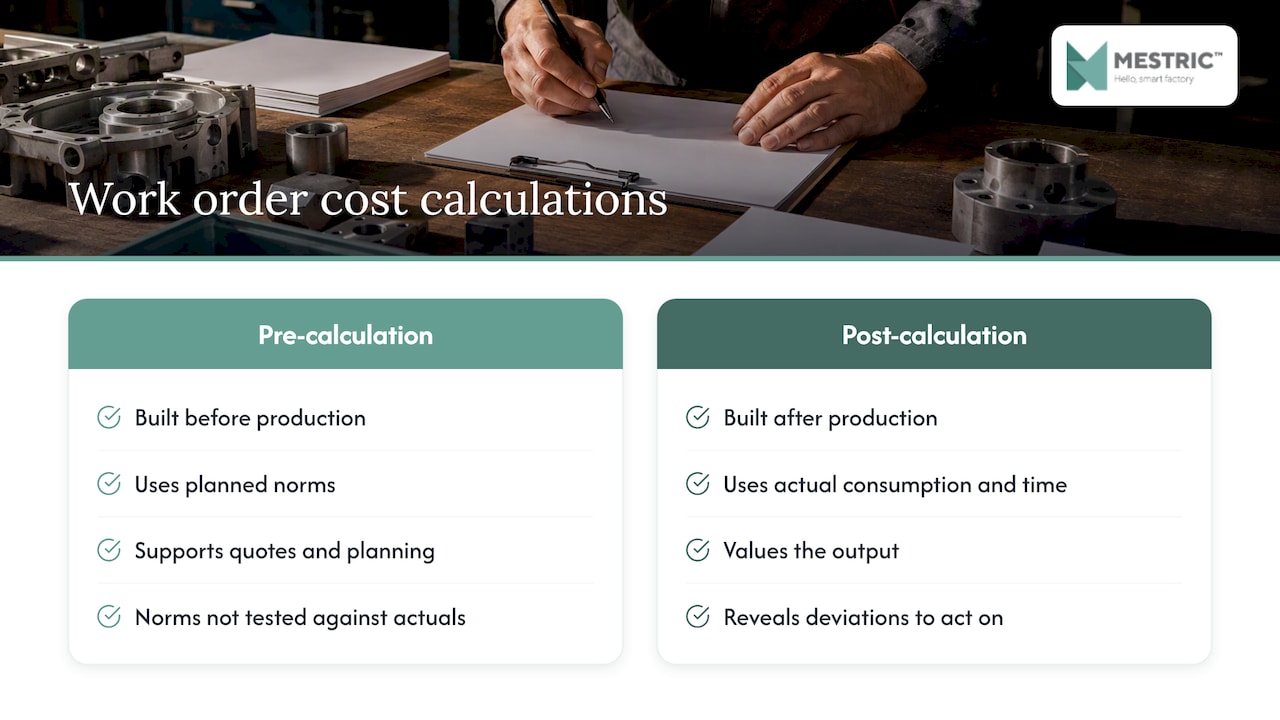
Pre-calculation (predkalkulacija). You build it before production from norms: how much material the bill of materials calls for, how many minutes each routing operation should take, which machine rate applies. It supports quotes, pricing and planning.
Post-calculation (pokalkulacija). You build it after production from what was actually consumed and how long operations actually ran. It values the output and shows what the order really cost.
University of Ljubljana research on managerial costing explains the logic: standard costs support planning and pricing, while comparison with actual historical costs reveals deviations that you can control and act on. If you only calculate after the fact, you learn about a loss when the goods are already shipped. If you only calculate before, you never test your norms.
Start with a correct bill of materials and routing. The bill of materials gives the quantity of each component per unit, including planned scrap. The routing lists operations, work centres, setup time and run time per unit. If these are outdated, every later number is wrong, however good your software is. Our guide to process norm optimisation from live data explains how to update norms from measured times instead of guesswork.
Assign a price to each material (average, FIFO or standard price, according to your accounting policy) and an hourly rate to each work centre and worker category. Machine rates should contain depreciation, energy and maintenance. Keep a record of the date and basis of every rate, because auditors and your own controllers will ask.
Multiply norms by prices. Add overhead using the allocation key your company has chosen, such as a percentage of direct labour or a rate per machine hour. Divide by the planned quantity to get the unit cost.
While the order runs, book:
Value the real consumption at the same prices, add overhead on the real hours, and divide by the good quantity. Note the denominator: scrapped units still cost money, so the cost per good piece is higher than the cost per piece started.
Split the difference into material variance (quantity and price), labour and machine variance (time and rate), and volume variance (planned versus produced). Each variance should have an owner and a cause, otherwise the report is only a number.
The figures below are invented to show the mechanics. They are not benchmarks.
A work order for 1,000 aluminium housings:
| Item | Planned | Actual |
|---|---|---|
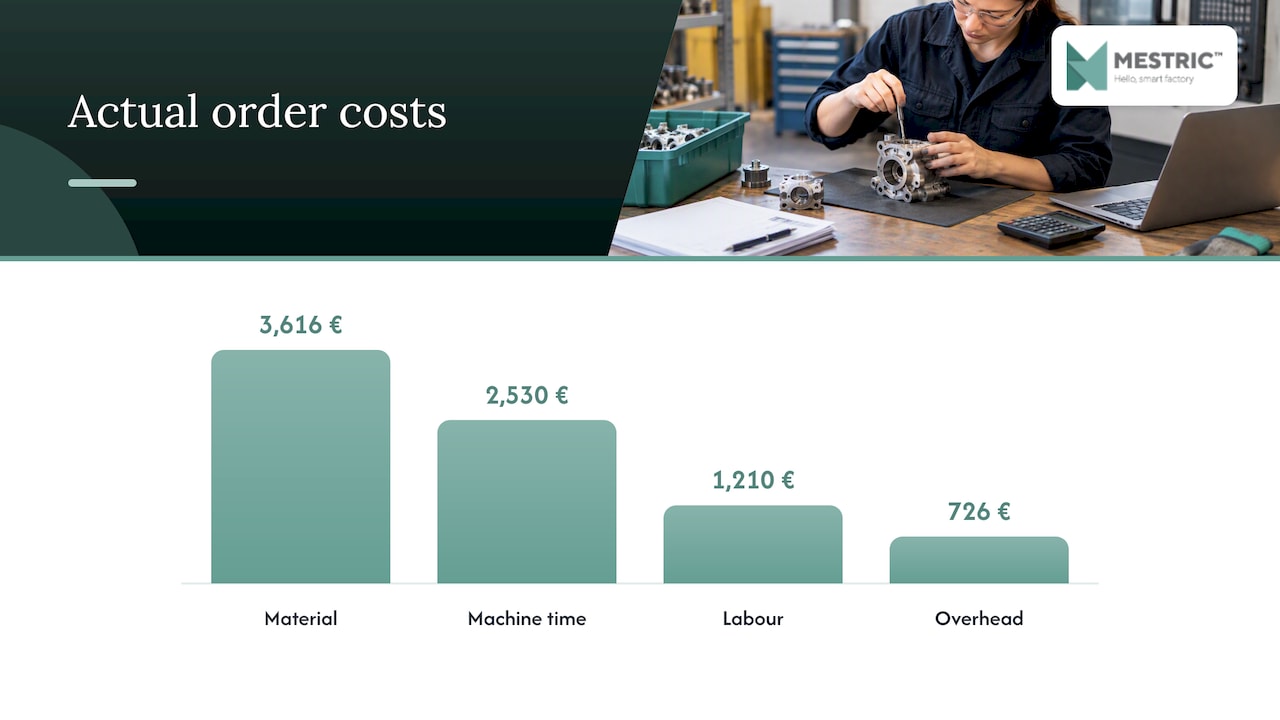
| Material | 1,050 kg at 3.20 € = 3,360 € | 1,130 kg at 3.20 € = 3,616 € |
| Machine time | 40 h at 55 € = 2,200 € | 46 h at 55 € = 2,530 € |
| Labour | 50 h at 22 € = 1,100 € | 55 h at 22 € = 1,210 € |
| Overhead (60 % of labour) | 660 € | 726 € |
| Total | 7,320 € | 8,082 € |
| Good units | 1,000 | 960 |
| Cost per good unit | 7.32 € | 8.42 € |
The order cost 762 € more than planned, but the cost per good unit rose by 1.10 €, about 15 %, because 40 units were rejected. A report showing only the total would hide that. The variance analysis points to three questions: why did 80 kg more material go in, why did the machine run six extra hours, and why did 4 % of units fail inspection? The answers might be a worn tool, a long changeover or an unstable setting. Each has a different fix.
Work order costs feed directly into the value of inventories, so they are not only an internal matter. The 2024 Slovenian Accounting Standards, mainly SRS 4 on inventories, determine how production costs are capitalised into finished goods and work in progress or recognised as expenses of the period. The standards are published in the official SRS 2024 e-book.
The academic analysis cited earlier also describes that stock can be valued at production cost in the broader sense (full) or in the narrower sense (variable), and notes that the chosen method significantly affects reported profitability. So agree the method with your finance team before you design the work order structure. Changing it later makes year-on-year comparison difficult.
If you want a broader theoretical grounding in direct and overhead costs and in job-order versus process costing, the University of Ljubljana cost accounting course covers exactly those topics.
The formula is simple. The data is the hard part. For each work order you need:
Typical failures are late booking at the end of the shift, rounding times to the nearest hour, forgetting returns of unused material, and recording downtime as run time. Each pushes cost to the wrong order and makes your norms look better than they are.
Three measures give most of the benefit.
Reuse norms. For repeated or similar orders, copy an existing bill of materials and routing and change only what differs. This cuts repeated manual typing and the errors that come with it.
Monitor production by operation. When you confirm operations, not just the whole order, the calculation can include work already completed and not only material consumed. That matters for orders that run for days or weeks.
Compare planned and actual on one screen. Reports that line up planned and consumed material, planned and actual operation time and downtime, and planned and produced quantity, together with order status, let supervisors act while the order is still running. Getting there requires data that is captured, not retyped. The guide to managing production in real time describes the setup.
An ERP system holds the norms, prices and the financial result. It usually does not know what happened on the machine minute by minute. A Manufacturing Execution System closes that gap: it connects to the equipment, records run time, stoppages, quantities and quality results per work order, and passes them on for costing. You can see how the layers differ in our overview of types of manufacturing software and in MES versus traditional manufacturing.
With automated data collection, three things change for costing:
The Mestric™ MES connects directly to production equipment and shows KPIs such as performance, downtime, quality parameters and cost analysis in one view, with AI-supported recommendations for process optimisation. You can also see it working on connected machines at our demonstration centre. If you are still weighing budget, read what an MES costs in Slovenia, and if you are ready to start, choose an MES and run a pilot in 8 weeks.
Most plants we speak to do not have a costing problem. They have a data timing problem. The formula for a work order cost fits on one page, and the finance team already knows it. What fails is the input: times written on paper at the end of a shift, downtime without a reason, scrap counted next day.
So we suggest starting small. Pick one line and one product family. Measure real operation times and downtime for a few weeks. Compare them to your norms. In nearly every case, a few norms turn out to be clearly off, and correcting those gives a more accurate cost than any new allocation formula.
Only then extend the approach to the whole plant. A calculation that supervisors can see during the order, not after it, changes behaviour. That is what we built Mestric™ for: to make the actual cost a by-product of production, not a monthly reconstruction.
— Andraž
Pre-calculation estimates the cost from norms before production, and you use it for quotes and planning. Post-calculation values what was actually consumed once the order is done. Comparing them shows whether your norms and prices match reality.
Direct material, direct labour, direct services, direct depreciation, and variable and fixed production overheads. Selling and general administration costs are normally left out, and only exceptional non-production costs may be included under the Slovenian Accounting Standards. Confirm the treatment with your accountant.
Include all costs of the order, scrapped units included, and divide by the good units only. This gives the true cost per sellable piece. Record scrap by operation so you can see where the loss starts.
Yes, for a small number of orders with simple routings. It becomes unreliable when times and quantities are typed in by hand across shifts. Once you run many orders in parallel, automatic capture from machines saves time and reduces errors.


 069 763 552